|
 |
 |
 |
 |
 |
 |
 |
 |

 |
Engine Helps Satellites Blast Off With Less Fuel
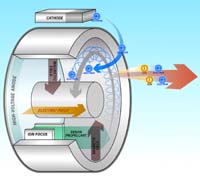
Atlanta GA (SPX) Feb 23, 2007 Georgia Tech researchers have developed a new protoype engine that allows satellites to take off with less fuel, opening the door for deep space missions, lower launch costs and more payload in orbit. The efficient satellite engine uses up to 40 percent less fuel by running on solar power while in space and by fine-tuning exhaust velocity. Satellites using the Georgia Tech engine to blast off can carry more payload thanks to the mass freed up by the smaller amount of fuel needed for the trip into orbit. Or, if engineers wanted to use the reduced fuel load another way, the satellite could be launched more cheaply by using a smaller launch vehicle. The fuel-efficiency improvements could also give satellites expanded capabilities, such as more maneuverability once in orbit or the ability to serve as a refueling or towing vehicle. The Georgia Tech project, lead by Dr. Mitchell Walker, an assistant professor in the Daniel Guggenheim School of Aerospace Engineering, was funded by a grant from the U.S. Air Force. The project team made significant experimental modifications to one of five donated satellite engines from aircraft engine manufacturer Pratt and Whitney to create the final prototype. The key to the engine improvements, said Walker, is the ability to optimize the use of available power, very similar to the transmission in a car. A traditional chemical rocket engine (attached to a satellite ready for launch) runs at maximum exhaust velocity until it reaches orbit, i.e. first gear. The new Georgia Tech engine allows ground control units to adjust the engine's operating gear based on the immediate propulsive need of the satellite. The engine operates in first gear to maximize acceleration during orbit transfers and then shifts to fifth gear once in the desired orbit. This allows the engine to burn at full capacity only during key moments and conserve fuel. "You can really tailor the exhaust velocity to what you need from the ground," Walker said. The Georgia Tech engine operates with an efficient ion propulsion system. Xenon (a noble gas) atoms are injected into the discharge chamber. The atoms are ionized, (electrons are stripped from their outer shell), which forms xenon ions. The light electrons are constrained by the magnetic field while the heavy ions are accelerated out into space by an electric field, propelling the satellite to high speeds. Tech's significant improvement to existing xenon propulsion systems is a new electric and magnetic field design that helps better control the exhaust particles, Walker said. Ground control units can then exercise this control remotely to conserve fuel. The satellite engine is almost ready for military applications, but may be several years away from commercial use, Walker added. Community Email This Article Comment On This Article Related Links Daniel Guggenheim School of Aerospace Engineering Rocket Science News at Space-Travel.Com Rocket Science News at Space-Travel.Com
 NASA Solicits Ideas For Constellation Ground Work
 Washington (SPX) Feb 10, 2007
NASA has issued a request for information soliciting ideas on ground processing services for its Constellation Program and the next generation of space vehicles. The request seeks input from industry to assist NASA in planning for the acquisition of ground processing, assembly, integration, test, launch and recovery services at the Kennedy Space Center in Florida. |
|
|

| The content herein, unless otherwise known to be public domain, are Copyright 1995-2006 - SpaceDaily.AFP and UPI Wire Stories are copyright Agence France-Presse and United Press International. ESA PortalReports are copyright European Space Agency. All NASA sourced material is public domain. Additionalcopyrights may apply in whole or part to other bona fide parties. Advertising does not imply endorsement,agreement or approval of any opinions, statements or information provided by SpaceDaily on any Web page published or hosted by SpaceDaily. Privacy Statement |