|
 |
 |
 |
 |
 |
 |
 |
 |

 |
Endurance Test on Cryogenic Engine Successful
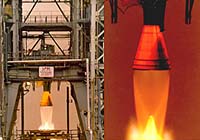
Bangalore - Dec 08, 2003 An endurance test for duration of more than 16 minutes on the indigenous Cryogenic Engine for Geo-synchronous Satellite Launch Vehicle, GSLV, was successfully conducted today (December 5, 2003) at ISRO's Liquid Propulsion Systems Centre (LPSC) at Mahendragiri in Tamil Nadu. The test involved the firing of the Cryogenic main Engine with 7.1 tonne thrust for 1000 seconds, simultaneously with two 200 kg thrust Cryogenic Steering Engines, all mounted on a single block as used in the actual GSLV flight stage developing 7.5 tonne total thrust. The steering engines are used to control the flight path of GSLV during the third stage thrusting. The turbo-pump fed, regeneratively cooled engine for the cryogenic stage is required to burn for a duration of 720 seconds in actual flight. The long duration test conducted today marks the conclusion of the qualification of the cryogenic engine, which has been tested for a cumulative duration of 6,000 seconds so far in three hardware. A number of specially established facilities like Assembly and Integration Facility, Test stand, state of the art Control Centre have been employed for the successful assembly and testing of engines. The development of the cryogenic stage system is also progressing well at LPSC, Thiruvananthapuram. This cryogenic stage, using a combination of two tonne liquid hydrogen and 11 tonne liquid oxygen, is intended to replace the Russian supplied cryogenic stage in GSLV. Dr G Madhavan Nair, Chairman, ISRO, Mr N Vedachalam, Director, LPSC, Dr B N Suresh, Director, Vikram Sarabhai Space Centre, Thiruvananthapuram, and other senior scientists of ISRO witnessed Friday's test. Community Email This Article Comment On This Article Related Links Indian Space Research Organisation SpaceDaily Search SpaceDaily Subscribe To SpaceDaily Express Rocket Science News at Space-Travel.Com
 Successful First Test For Vega's Zefiro 9 Engine
 Paris, France(ESA) Dec 28, 2005
Flames, smoke and a deafening noise accompanied the first firing test of Vega's Zefiro 9 third-stage solid rocket motor. A first examination of the data indicates that everything went well at the test carried out yesterday at Salto de Quirra in southeast Sardinia. |
|
|

| The content herein, unless otherwise known to be public domain, are Copyright 1995-2006 - SpaceDaily.AFP and UPI Wire Stories are copyright Agence France-Presse and United Press International. ESA PortalReports are copyright European Space Agency. All NASA sourced material is public domain. Additionalcopyrights may apply in whole or part to other bona fide parties. Advertising does not imply endorsement,agreement or approval of any opinions, statements or information provided by SpaceDaily on any Web page published or hosted by SpaceDaily. Privacy Statement |