|
 |
 |
 |
 |
 |
 |
 |
 |

 |
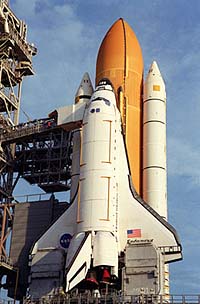
Endeavour Ready To Close Out 2001
Houston - Nov. 28, 2001 Operations remain on schedule for the launch of Shuttle Endeavour on the STS-108 mission on Thursday, Nov. 29. At Pad 39B, cryogenic loading of the fuel cells was completed early this morning. Final main engine preps are under way, and the countdown will enter the next planned built-in hold of 12 hours, 49 minutes at 3 p.m. Late stowage operations are scheduled for this evening, and the rotating service structure will be moved to the parked position at 11:30 p.m. Fuel cell activation will begin at 4:50 a.m.Thursday morning. A two-hour built-in-hold will be will be called at 8:46 a.m., at which time Shuttle managers will assess status for loading the liquid oxygen and liquid hydrogen propellants aboard the External Tank. ET tanking is scheduled to start at 10:16 a.m. Air Force meteorologists released a more optimistic forecast this morning, reducing the probability of weather prohibiting the launch to 30 percent because of possible low cloud ceilings. The forecast calls for a few clouds from 3,000 to 7,000 feet and a scattered layer at 20,000 feet. The temperature at launch time will be 74 degrees F, with winds from the southeast at 12-18 knots. In the Solid Rocket Booster recovery area, the sea state will be 7-9 feet, with winds from the southeast at 17-22 knots and a water temperature of 78 degrees. An unmanned Russian Progress resupply vehicle successfully docked to the International Space Station this afternoon, carrying food, fuel and supplies for the next residents of the orbital outpost. The Progress 6 craft, which launched from the Baikonur Cosmodrome in Kazakhstan Monday, gently docked to the aft port of the Zvezda Service Module over Central Asia at 1:43 p.m. CST, completing a two-day automated flight. On board the station, Expedition Three Commander Frank Culbertson, Pilot Vladimir Dezhurov and Flight Engineer Mikhail Tyurin monitored the docking, and prepared for the opening of the hatch between Zvezda and Progress later today. The Progress is carrying more than a ton of food, fuel and equipment for the Expedition Four crew, Russian Commander Yury Onufrienko and U.S. Astronauts Dan Bursch and Carl Walz, who are scheduled to be launched aboard the shuttle Endeavour tomorrow night on the STS-108 mission to relieve the Expedition Three crew, which has been in orbit since August. They will be ferried to the ISS by Endeavour Commander Dom Gorie, Pilot Mark Kelly and Mission Specialists Linda Godwin and Dan Tani. Launch from the Kennedy Space Center is scheduled for 6:41 p.m. CST. The Expedition Three crew and the science team on the ground are also wrapping up their research program and preparing precious science experiments and samples from their three-month mission for the return to Earth on the upcoming UF-1 Space Shuttle mission to the space station. During the past two weeks, Commander Frank Culbertson and Flight Engineers Mikhail Tyurin and Vladimir Dezhurov completed their final sessions of the Hoffman Reflex, Pulmonary Function in Flight, Renal Stone and Crew Interactions research programs and completed experiment hardware transfers in the Destiny lab module that will support Expedition Four research activities. Their effort drew praise from many of the experiment teams in the weekly science summary faxed to the crew. "I'd like to express on behalf of the Payloads Office, our profound gratitude for all that you have done for us during the expedition," summarized John Uri, lead scientist for the Expedition. "Many of the experiments were completed last week, especially with the extra time you've dedicated to completing the research. From our point of view, this has been a highly successful expedition, some experiments getting even more than expected. I look forward to seeing you back on Earth." Automated experiments continue to run in the Destiny lab, controlled by science teams on the ground. The Dynamically Controlled Protein Crystal Growth (DCPCG) and Advanced Protein Crystallization Facility (APCF) are scheduled for deactivation on Thursday in conjunction with the launch of STS-108. The Physics of Colloids in Space completed a 24-hour run on Tuesday, re-homogenizing the colloid polymer gel sample and running various diagnostics to measure the process. Two vibration-measuring experiments, the Space Acceleration Measurement System and the Microgravity Acceleration Measurement System, recorded the November 22 undocking of the Russian Progress 5 spacecraft and are expected to collect data during today's (Nov. 28) Progress 6 docking. The Crew Earth Observations science team sent a list of geographic sites for photography that should last through November 30, the last until STS-108 undocks. The sites include snow cover in the South Sandwich Islands, air quality in southern Africa, Chilean glaciers, water level changes in Lake Poopo in Bolivia, coral reefs in American Samoa, and agriculture in the Parana River area of South America. In response to Commander Frank Culbertson's request for more photography sites, the team has offered to send him a copy of the daily site list for the STS-108 crew. Following data earlier this week indicating a potential problem with the Active Rack Isolation System, the ground team asked Culbertson to use a set of pliers to tighten the screws on two upper pushrods. Culbertson radioed Monday that he had completed that work, and tests of the vibration dampening system resumed this week. Located in EXPRESS Rack 2, ARIS is designed to provide a reactive force to vibrations caused by crew activities, operating equipment and other disturbances that could harm delicate microgravity experiments in the rack. Several experiments will be returning to Earth along with the Expedition Three crew. In addition to DCPCG and APCF, the Shuttle will return with cell samples from the Cellular Biotechnology Operations Support System, urine samples and other data from the Renal Stone experiment, the Bonner Ball Neutron Detector, and the DREAMTiME high definition TV camera. The crew plans to record the STS-108 arrival and ingress before stowing the camera and equipment for return. Community Email This Article Comment On This Article Related Links ISS and Shuttle Portal at NASA ISS Space Science SpaceDaily Search SpaceDaily Subscribe To SpaceDaily Express Space Shuttle News at Space-Travel.Com
 NASA's Soyuz Deal Will Not Scrap Shuttle
 Washington DC (SPX) Jan 11 2006
NASA's announcement last week that it will pay Roskosmos $43.8 million to transport one astronaut to and another one from the International Space Station this year represents the agency's acknowledgment that it has no immediate alternative if it wishes to continue its presence and participation in the orbiting facility. |
|
|

| The content herein, unless otherwise known to be public domain, are Copyright 1995-2006 - SpaceDaily.AFP and UPI Wire Stories are copyright Agence France-Presse and United Press International. ESA PortalReports are copyright European Space Agency. All NASA sourced material is public domain. Additionalcopyrights may apply in whole or part to other bona fide parties. Advertising does not imply endorsement,agreement or approval of any opinions, statements or information provided by SpaceDaily on any Web page published or hosted by SpaceDaily. Privacy Statement |