|
 |
 |
 |
 |
 |
 |
 |
 |

 |
Endeavour Docks With ISS
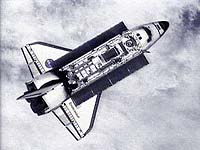
Houston - Dec. 2, 2000 Endeavour docked with ISS at 2 pm central time Saturday and took the first step in providing additional power to the orbiting complex in preparation for the first of three planned spacewalks Sunday. With Expedition One crewmembers Bill Shepherd, Yuri Gidzenko and Sergei Krikalev looking on, Commander Brent Jett guided the Shuttle to a smooth linkup with the ISS as the two craft sailed 230 statute miles above northeast Kazakhstan. Endeavour is attached to a new station docking port installed last month by the STS-92 astronauts. The ISS residents went to sleep a short time after docking, to be awakened just after midnight for their 32nd day aboard the station. The station and shuttle crews are maintaining separate sleep cycles to match the work they need to accomplish during their week of joint activities. A little over two hours after docking, Canadian Space Agency astronaut Marc Garneau maneuvered Endeavour�s Canadian-built robot arm and grappled the 45-foot-long, 17 1/2 ton P6 solar array truss structure at 4:17 p.m., lifting it out of its berthing latches in the shuttle�s cargo bay a few minutes later. Garneau tilted the truss structure 30-degrees to the cargo bay, where it will remain overnight attached to the arm to properly warm its components. The P6 will be mated to the Z1 external truss atop the Unity module Sunday by Garneau with the assistance of spacewalkers Joe Tanner and Carlos Noriega during their 6�-hour excursion outside Endeavour. After leak checks were completed between the two vehicles, and with Pilot Mike Bloomfield looking on, Tanner and Noriega made their way through Endeavour�s docking tunnel and opened the hatch to the ISS docking port to leave supplies and computer hardware on the doorstep of the station. The hatch refused to open at first because of a slight pressure differential between Endeavour and the ISS, but Tanner used a little muscle to finally push it free. Shepherd and his crewmates are scheduled to enter the Unity module for the first time Sunday morning and will open their hatch to the docking adapter to retrieve the items left behind by their shuttle counterparts. The two crews will not greet each other face-to-face until Friday morning when the hatches are open between the two spacecraft following completion of the spacewalks. Once the P6 is mated to the Z1 truss, the solar arrays tower will be commanded to unfurl, increasing the power supply to the ISS by five times its current output. The spacewalk by Tanner and Noriega is scheduled to begin at about 12:30 p.m. Sunday, but could start as much as 45 minutes earlier if they complete preparations ahead of schedule. Endeavour�s astronauts were set to begin an eight-hour sleep period at about 11:30 tonight and will be awakened at 7:36 a.m. Sunday. The Endeavour-ISS complex is orbiting the Earth at an altitude of 235 statute miles with all systems operating in excellent fashion. The next STS-97 status report will be issued Sunday morning after the Shuttle crew is awakened. Community Email This Article Comment On This Article Related Links ISS and Shuttle Portal at NASA SpaceDaily Search SpaceDaily Subscribe To SpaceDaily Express Space Technology News - Applications and Research
 Industry Team Achieve New Communications Technology With AESA Radars
 Baltimore MD (SPX) Jan 12, 2006
A team comprised of three leading US aerospace and defense contractors has demonstrated an innovative technological use of active electronically scanned array (AESA) radars for high-bandwidth communications. |
|
|

|
|
|
|
|
|
|
|
|
|
|
|
| The content herein, unless otherwise known to be public domain, are Copyright 1995-2006 - SpaceDaily.AFP and UPI Wire Stories are copyright Agence France-Presse and United Press International. ESA PortalReports are copyright European Space Agency. All NASA sourced material is public domain. Additionalcopyrights may apply in whole or part to other bona fide parties. Advertising does not imply endorsement,agreement or approval of any opinions, statements or information provided by SpaceDaily on any Web page published or hosted by SpaceDaily. Privacy Statement |