|
 |
 |
 |
 |
 |
 |
 |
 |

 |
Endangered Coral Points To El Nino Frequency
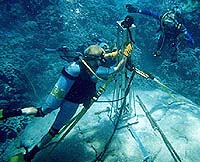
Tucson - Oct. 25, 2000 Since the mid-1970s, El Nino events are recurring about three times more often than they did in the mid-19th century, judging from an analysis by two University of Arizona geologists that will be published in Nature on Thursday (October 26). Julia Cole and Jonathan Overpeck of the UA department of geosciences, along with their former graduate student, Frank Urban, based their analysis on a 155-year core extracted from a living coral reef in the middle of the Pacific Ocean. The coral was growing in a ring of tiny Pacific islands collectively known as Kiribati. "It's the center of action for El Nino. It's right at the edge of the Pacific warm pool," Cole explained. Most years, warm surface water piles up on the western side of the Pacific Ocean near Australia. The easterly tropical trade winds help keep them in their place. But during El Nino years, the winds die down and the warm pool starts spreading into the eastern Pacific and the Kiribati islands. "With that warm water moving eastward, you get the rainfall moving eastward," Cole said. "During El Nino years, the maximum rainfall tends to sit near the dateline and equator, which is right where our coral sits." Warm water means more rainfall in part because heat rises. So warm water evaporates more easily than cooler water. And air heated by the warm water rises more easily to the heights necessary to create clouds and rain. Eventually the warm pool reaches the shores of Peru, whose inhabitants were the first to christen it "El Nino." During El Nino years, rainfall tends to increase in Peru -- and even in Tucson, due to other, more complex patterns of atmospheric circulation. Meanwhile, rainfall decreases in other regions, such as the Pacific Northwestern United States. It's fortunate for the researchers that at their study site, rainfall tends to track higher sea surface temperatures, because the isotopic signature in the coral doesn't distinguish between increased temperatures and increased input of fresh water. As the water in which the corals live becomes warmer or "fresher," the corals will increasingly avoid an isotope of oxygen that is slightly heavier than the typical oxygen atom. This predictable habit allowed the researchers to use the proportion of heavy oxygen isotopes in a segment of coral reef to interpret the history of warm/wet El Nino episodes during the coral's lifetime. But first, they had to identify the annual layers in the coral. They did this by X-raying the coral segments, so they could see the changes in density that announce the end of a round of annual growth. After confirming that their coral record accurately mirrored the ups and downs of modern El Nino events, Cole and Overpeck felt confident in extending the El Nino record back in time. That's when all the effort began to pay off, because modern instrumental records of El Nino cycles go back only a few decades. They found that El Nino events from about 1840 through 1880 recurred on a nearly decadal cycle, about every 12 years. "The longer time scale that we see in the past is not something we've observed in the 20th century," Cole noted. El Nino appears to have been on a three-year return period from 1880 to 1920, their analysis indicated. From about 1920 to the mid-1970s, the El Nino events became less regular on a 5- to 7-year cycle. Modern-day El Nino events have been recurring about every four years since the mid-1970s. Cole finds it intriguing that the latest change occurred at the same time as a documented upswing in global temperatures, which has been pinpointed at 1976. The observed global warming is considered at least partly a result of an input of greenhouse gases from fossil fuels and other human activities. "We're certainly seeing signs in this area that the climate is warmer and wetter than it used to be. It is consistent with the argument that this is linked to global warming," she said. However, scientists cannot say with certainty that global warming will increase the frequency of El Nino events. After all, the system shifted to a cycle even shorter than today's around the turn of the 19th Century. "What we can say is that as the background climate changes, for example due to global warming, we're likely to see changes in the frequency of El Nino events," Cole noted. The warming that corals record is also a potential threat to their well-being. A widespread episode of "bleaching" of corals around Africa occurred with warmer temperatures during 1997-98 and threatens to kill many long-lived coral reefs there. This past summer, Cole rushed to the region to collect more samples before the corals eroded away. "The unfortunate part of the story is that record warm ocean temperatures are teaming up with pollution and other human activities to kill corals around the world," Overpeck noted. "This means that these kinds of records from living corals are becoming increasingly rare." Community Email This Article Comment On This Article Related Links University of Arizona SpaceDaily Search SpaceDaily Subscribe To SpaceDaily Express Dirt, rocks and all the stuff we stand on firmly
 Environmental Damage Threatens Human Health
 Bangkok (AFP) Dec 9, 2005
Environmental damage threatens human health and may have contributed to the spread of new diseases like bird flu and SARS, the World Health Organization said in a report Friday. |
|
|

|
|
|
|
|
|
|
|
|
|
|
|
| The content herein, unless otherwise known to be public domain, are Copyright 1995-2006 - SpaceDaily.AFP and UPI Wire Stories are copyright Agence France-Presse and United Press International. ESA PortalReports are copyright European Space Agency. All NASA sourced material is public domain. Additionalcopyrights may apply in whole or part to other bona fide parties. Advertising does not imply endorsement,agreement or approval of any opinions, statements or information provided by SpaceDaily on any Web page published or hosted by SpaceDaily. Privacy Statement |