|
 |
 |
 |
 |
 |
 |
 |
 |

 |
Encore: What's Next Beyond LEO
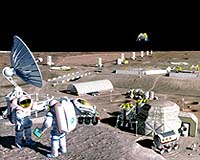
Moffett Field (SPX) May 04, 2004 On December 11, 1972 - thirty-one years ago- the astronauts of Apollo 17 eased their Lunar Module into a landing, beginning the last human excursion to the Moon. Three days later, Eugene Cernan and Harrison Schmitt blasted off from the lunar surface to rejoin crewmate Ronald Evans in the Command/Service Module. The crew circled the Moon for another forty-eight hours or so, fired the spacecraft's thruster, and left the Moon behind for the next three decades. During their brief stay on the Moon, Commander Cernan and geologist Schmitt crisscrossed the local terrain in their Lunar Rover, conducting a variety of experiments and gathering Moon rocks to bring home. Thirty year later, there's a resurgence of interest in returning to the Moon. The Moon is believed to play an important role in Earth's habitability . Because the Moon helps stabilize the tilt of the Earth's rotation, it prevents the Earth from wobbling between climatic extremes. Without the Moon, seasonal shifts would likely outpace even the most adaptable forms of life. In addition, because our moon is lifeless, it is one of the most appealing places to look for the preserved records of life elsewhere. At least according to recent estimates for the amount of ejected rocks that might survive there, the Moon may hold clues from the early history of Mars, Venus and Earth. Unfortunately, the very early geological history of Earth has been nearly completely obliterated by the actions of tectonics, weathering, and biology; on our home planet the earliest rock records date back about 3.8 billion years but no further. Scientists John Armstrong and Lloyd Wells of the University of Washington in Seattle and Guillermo Gonzalez of Iowa State University argue for resuming human missions to the Moon to collect not Moon rocks, but Earth rocks. Early in Earth's history, a rain of comets known as the Late Heavy Bombardment may have blasted bits of Earth's surface into space; some of the material might now lie strewn across the lunar surface. The rocks might even contain fossil evidence of the earliest life on Earth life, the researchers say. Scientist Kevin Zahnle of NASA Ames Research Center adds that studying the existing collection of Moon rocks returned by Apollo 17 and the five earlier lunar landings could help test techniques for searching for Earth rocks on the Moon. And NASA astrobiologist David McKay of Johnson Space Center has remarked that, to his knowledge, no one has searched the collection of Moon rocks for Earth minerals. The Moon, however, still retains some of the earliest records of the formation of the Earth-Moon system. Leading models suggest a very early origin of the Moon as a result of the collision of a Mars-sized body with the newly formed Earth. Samples from the Apollo and Luna programs elucidated some of this history, but the nature of these samples, limited to equatorial regions of the lunar near side, leaves many key questions unanswered. The Moon's South Pole-Aitken Basin, one of the largest impact structures known within the solar system, exposes material from deep within the crust and possibly even the upper mantle that was excavated by the impact. In addition, the floor of this basin probably retains impact melt rocks created by the giant impact. Apollo experience shows that such melt rocks provide insight into the average composition of the basin, and that by dating such samples we can infer the age of the basin itself. This will help to resolve questions that are raised by the observed cratering record of the lunar highlands, with important implications for the early history of the Moon and all of the terrestrial planets, including Earth. Analysis of ancient lunar material will thus provide critical insights into the processes that occurred on Earth and the other terrestrial planets during their early history. For more than 40 years, the Moon has been visited by automated space probes and by nine manned expeditions, six of which landed on its surface. Most recently on the night of September 27th, 2003, Europe's lunar probe called SMART-1 launched on a technology demonstration mission to the moon. Much remains to be learnt about our closest neighbour, and SMART-1's payload will conduct observations never performed before in such detail. The Advanced/Moon Micro-Imaging Experiment (AMIE) miniaturized CCD camera will provide high-resolution and high-sensitivity imagery of the surface, even in poorly lit polar areas. The highly compact infrared spectrometer will map lunar materials and look for water and carbon dioxide ice in permanently shadowed craters. Although the recent history of lunar missions has been dominated by robotic probes, revisions to the future timeline may be forthcoming if the Presidential Commission on Moon to Mars and Beyond continues to develop towards fruition. As Chaikin noted in his lecture series on the subject, it remains a remarkable realization however, that it was 31 years ago that the last human left the moon. This story was published as a four part series. Click For Part 1, 2 or 3
Article is courtesy of NASA's Astrobiology Magazine team at Ames Research Center. This article is public domain and available for reprint with appropriate credit. Community Email This Article Comment On This Article Related Links SpaceDaily Search SpaceDaily Subscribe To SpaceDaily Express Space Tourism, Space Transport and Space Exploration News
 Spicing Up Space Meals
 Los Angeles CA (SPX) Jan 04, 2006
Since its launch a year and half ago, Minimus.biz has quickly become the place to go for individual and travel size items. Last week, NASA came to Minimus.biz and purchased several different travel size condiments to send with the astronauts to the International Space Station. |
|
|

| The content herein, unless otherwise known to be public domain, are Copyright 1995-2006 - SpaceDaily.AFP and UPI Wire Stories are copyright Agence France-Presse and United Press International. ESA PortalReports are copyright European Space Agency. All NASA sourced material is public domain. Additionalcopyrights may apply in whole or part to other bona fide parties. Advertising does not imply endorsement,agreement or approval of any opinions, statements or information provided by SpaceDaily on any Web page published or hosted by SpaceDaily. Privacy Statement |