|
 |
 |
 |
 |
 |
 |
 |
 |

 |
Enceladus: Grand Tours
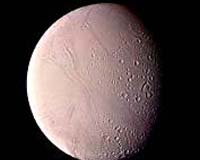
Moffet Field CA (SPX) Aug 30, 2004 Two hundred and fifteen years ago today (August 28), Sir William Herschel discovered Saturn's moon Enceladus (499 kilometers, 310 miles across). A mission goal for Cassini is to determine the composition of moons like Enceladus. Along with most of the other 33 satellites, Enceladus appears to have an icy crust. Condensed ices give the moons very high albedo (reflection coefficients) but are mottled with darker regions that may be rich in organic chemicals like methane or ammonia. These building blocks for primitive biochemistry may offer insight into how a similar, but much warmer environment on Earth, might have given rise to primordial life. Cassini will conduct its four-year orbital mission, circling Saturn 77 times and cruising by more than 50 close encounters (and another dozen or so more-distant encounters) with the planet's moons. In all, Cassini will aim its instruments at 8 of Saturn's 33 known moons. Cassini has already discovered a few that were unknown from ground observation and an earlier Voyager flyby. Titan will get the lion's share of attention: 45 close flybys are planned for the giant moon. Titan will also be the target of the Huygens probe, which will be released by Cassini on Christmas day (Christmas eve in the U.S.) for descent through Titan's atmosphere 3 weeks later. Titan is of particular interest to scientists because, like Earth, it has an atmosphere that contains nitrogen and organic molecules such as methane. Some scientists speculate that Titan's chemistry may offer a snapshot of what Earth's chemistry was like before life took hold. After Cassini releases the Huygens probe, it will spend about 10 exploring several of Saturn's icy satellites. Cassini will make close flybys of Enceladus, Hyperion, Dione and Rhea during this grand lunar tour. Community Email This Article Comment On This Article Related Links Cassini at JPL Cassini Image Team SpaceDaily Search SpaceDaily Subscribe To SpaceDaily Express Explore The Ring World of Saturn and her moons Jupiter and its Moons The million outer planets of a star called Sol News Flash at Mercury
 Cassini Images Halo Around Titanic Moon Off Saturn
 Pasadena CA (SPX) Dec 27, 2005
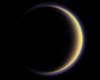
With its thick, distended atmosphere, Titan's orange globe shines softly, encircled by a thin halo of purple light-scattering haze. |
|
|

| The content herein, unless otherwise known to be public domain, are Copyright 1995-2006 - SpaceDaily.AFP and UPI Wire Stories are copyright Agence France-Presse and United Press International. ESA PortalReports are copyright European Space Agency. All NASA sourced material is public domain. Additionalcopyrights may apply in whole or part to other bona fide parties. Advertising does not imply endorsement,agreement or approval of any opinions, statements or information provided by SpaceDaily on any Web page published or hosted by SpaceDaily. Privacy Statement |