|
 |
 |
 |
 |
 |
 |
 |
 |

 |
Enceladus Exudes Air Of Mystery
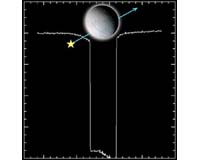
Pasadena CA (SPX) Jul 04, 2006 Atomic oxygen could never be confused with expensive perfume, but just as a fragrance lingering in the air of an empty room offers hints about a previous occupant, the cloud of oxygen the Cassini spacecraft encountered as it first approached Saturn turned out to be a calling card from another celestial presence, the tiny moon Enceladus. Oxygen was the first clue that much more is going on beneath Enceladus' icy surface than it first appeared. It took a while for scientists to get the message. Tracking down the oxygen's source led them to a most unusual spot in the solar system, a place that may possess one of the rarest and most sought-after substances in the universe - liquid water. Cassini's ultraviolet imaging spectrograph made its initial survey of Saturn's atmosphere late in December 2003 as the spacecraft neared the end of its seven-year voyage to the ringed planet. Along with the expected hydrogen, long known to be the gas giant's major component, the spectrograph detected the presence of oxygen. "We were the first to discover the oxygen in the Saturn system," said Larry Esposito of the University of Colorado, principal investigator for the instrument. Saturn's rings are made mostly of water ice, but it wasn't surprising to find one ingredient of water, oxygen, in Saturn's atmosphere, Esposito explained. The oxygen they observed was in the form of single oxygen atoms, called atomic oxygen, like that in water. In January 2004, when it looked again at Saturn's atmosphere, it found a massive bubble of oxygen near Saturn's outermost ring, the E ring. Then just a few months later, much of the oxygen was gone. "What was surprising was the amount of oxygen we saw and how it changed," Esposito said. "This was the first sign that something unusual was going on." "Our first idea was that the collisions between small moons in the rings would release small puffs of ice and that ice would be broken down into its atoms, one of which would be atomic oxygen," he said. "We put out this hypothesis, but the idea didn't seem to be working out." What did work out were a host of observations in spring 2005 showing that something very odd was taking place on Enceladus, which just happens to orbit within the E ring, where the mysterious cloud of oxygen was first discovered. Cassini's magnetometer showed that the moon had an atmosphere. Too small to have enough gravity to hold on to an atmosphere for very long, Enceladus had to have a steady source of gas, such as geysers, to keep an atmosphere going. The cosmic dust analyzer detected a stream of particles around Enceladus. The scientists wondered whether these particles could be coming from the moon or from the E ring and if, perhaps, the moon itself might be the source of ice particles for the E ring. The Cassini science teams were eager to get a closer look. Mission navigators re-designed the spacecraft's trajectory to bring it closer to Enceladus than had been previously planned. "This is a big advantage of a mission like Cassini," Esposito said. "You don't just fly by once, you can follow-up when something seems promising." In July 2005, Cassini cruised only 175 kilometers (109 miles) from Enceladus. The spacecraft's instruments revealed that the large dark cracks, dubbed "tiger stripes," on the moon's south pole were warm and spewing out water vapor and ice particles. The flyby occurred just when a star was moving behind the moon's southern pole. "As we watched the moon extinguish the light from the star, the spectrometer identified oxygen," Esposito said. "The starlight showed water molecules between us - the spacecraft - and the star. It showed a localized cloud of water near Enceladus." He said the mission team was able to measure the shape of the cloud, estimate the amount of water it contained and the rate it would be destroyed and produce oxygen. The amount of water they saw, about a million tons, was exactly that needed to provide a cloud of oxygen like the one they had first observed near the E ring more than a year earlier. "This was a most pleasing result," Esposito said. "We measured two new distinct phenomena and found that they fit together." The mystery of the atomic oxygen was solved. At the same time, its source, the diminutive Enceladus revealed itself to be completely different than the cold, dead icy moon it should have been. Small as it is, Enceladus harbors an internal heat source and is geologically active. Its geysers throw out enough water vapor and ice to maintain the moon's atmosphere, feed the vast E ring, and decompose into clouds of oxygen like the one first spotted by Cassini on its way to Saturn. Not far beneath the moon's snowy white surface, scientists suspect, might be large pools of liquid water, warmed by the same heat source that powers its geysers. Its potential for water puts Enceladus into an elite group of places where life could exist. Cassini will swing back in 2008 for another look. Community Email This Article Comment On This Article Related Links Enceladus info at NASA Cassini at JPL Cassini images Explore The Ring World of Saturn and her moons Jupiter and its Moons The million outer planets of a star called Sol News Flash at Mercury
 Cassini Spots Another New Tiny Saturn Moon
 Pasadena CA (SPX) Jul 13, 2006
This magnified view shows tiny Polydeuces, a moon discovered by NASA's Cassini spacecraft last month, is a mere 3 kilometers (2 miles) across. Along with much larger Helene (32 kilometers, or 20 miles across), Polydeuces orbits Saturn at the same distance as large, icy Dione (1,126 kilometers, or 700 miles across). |
|
|

| The content herein, unless otherwise known to be public domain, are Copyright 1995-2006 - SpaceDaily.AFP and UPI Wire Stories are copyright Agence France-Presse and United Press International. ESA PortalReports are copyright European Space Agency. All NASA sourced material is public domain. Additionalcopyrights may apply in whole or part to other bona fide parties. Advertising does not imply endorsement,agreement or approval of any opinions, statements or information provided by SpaceDaily on any Web page published or hosted by SpaceDaily. Privacy Statement |