|
 |
 |
 |
 |
 |
 |
 |
 |

 |
Emory Chemists Create Unprecedented Metallic Molecule
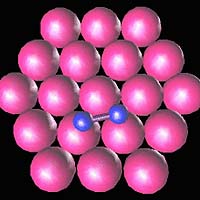
Atlanta GA (SPX) Nov 26, 2004 For the first time ever, Emory University researchers have broken through the so-called "oxo-wall" to create stable multiple chemical bonds between oxygen and platinum � once thought impossible because oxygen is extremely unstable when combined with certain metals. The breakthrough holds the potential for numerous applications in fuel cells, catalytic converters and emerging 'green' chemistry. Chemical bonds between metals and oxygen are known as metal-oxo species, and are found in a multitude of molecules and materials. They are dominant in the chemistry, geology and biology of many metal elements, especially during oxidation � one of the most basic and fundamental of chemical reactions. However, metal-oxo species become increasingly less stable as one moves from left to right on the periodic table. Until this work, attempts to create metal-oxo species with elements such as gold, platinum, silver, iridium and rhodium have been unsuccessful. "The existence of such metal-oxo complexes has been presented and debated in many public forums but never realized until this research. Since this metal-oxo is a unique compound, both its physical properties and its chemical reactivities should provide new insights and break new ground," says principal investigator Craig Hill, Goodrich C. White Professor of Chemistry at Emory. The paper appears in the Nov. 25 edition of Science Express, an online publication of selected research papers that have recently been accepted for publication in the journal Science. "Oxygen is usually very unreactive in its molecular state as O2, or, when you do break the bond, it reacts uncontrollably. In nature, iron is one of the most versatile elements in its ability to control oxygen, and can pluck a single oxygen atom and transfer it where it wants to go. We wanted to take what nature knows how to do with iron, and do it ourselves with other metals," says Travis Anderson, lead post-doctoral researcher for the project. He says the next step will be to create metal-oxo bonds with platinum's neighbors on the periodic table. "Out of the 12 metals that have been behind this 'oxo-wall' in columns 9-12 of the periodic table it is very exciting that we were able to create metal-oxo compound with platinum since it is an excellent catalyst for environmentally friendly processes," Anderson says. Stable compounds of platinum and oxygen could be centrally important to the operation of automobile catalytic converters. Catalytic converters use a platinum catalyst to interact with oxygen in the air to form highly reactive platinum-oxygen intermediates and other species that fully combust the partially burned fossil fuels emanating from the internal combustion engine. The platinum-oxo compound is expected to be a model for these highly elusive platinum-oxygen intermediates and, as such, could provide key insights into improving existing technology. One important and growing technology where the platinum-oxo unit may also be key is fuel cells. The electrodes in these cells are frequently based on platinum, and in some instances the reaction of platinum with oxygen is central to their operation. In addition, metallic platinum has long been known to be an excellent catalyst for oxidations of organic compounds. Today, oxidations by O2 (including air) are of considerable and growing interest in part because they are quite green. In other words, such organic oxidations, which are important in several industries, can, in principle, generate fewer inorganic by-products, work under more benign conditions, permit products to be separated more easily and generate less waste. Platinum-oxo species could well be the critical intermediates in these diverse O2-based oxidations. The Science paper was authored by Hill; Anderson; chemistry professor Keiji Morokuma; Jamal Musaev, manager of Emory's Cherry L. Emerson Center for Computational Chemistry; Emory graduate students Wade Neiwert and Rui Cao; and collaborators at Argonne National Lab and the University of New Mexico. Community Email This Article Comment On This Article Related Links Emory University Health Sciences Center SpaceDaily Search SpaceDaily Subscribe To SpaceDaily Express Space Technology News - Applications and Research
 NGC Chosen To Proceed With Developing Solid-State Laser Technology For Military Applications
 Redondo Beach CA (SPX) Jan 09, 2006
Northrop Grumman Corporation has been selected to develop "military-grade," solid-state laser technology that is expected to pave the way for the U.S. military to incorporate high-energy laser systems across all services, including ships, manned and unmanned aircraft, and ground vehicles. |
|
|

| The content herein, unless otherwise known to be public domain, are Copyright 1995-2006 - SpaceDaily.AFP and UPI Wire Stories are copyright Agence France-Presse and United Press International. ESA PortalReports are copyright European Space Agency. All NASA sourced material is public domain. Additionalcopyrights may apply in whole or part to other bona fide parties. Advertising does not imply endorsement,agreement or approval of any opinions, statements or information provided by SpaceDaily on any Web page published or hosted by SpaceDaily. Privacy Statement |