|
 |
 |
 |
 |
 |
 |
 |
 |

 |
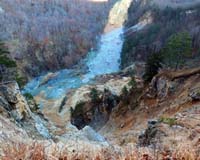
Emergency Workers Clear Landslide Debris In Montenegro Canyon
Podgorica (AFP) Nov 24, 2006 Emergency workers managed on Friday to partially clear a massive rock landslide blocking a UNESCO-protected river canyon in Montenegro, lowering the danger of severe flooding in the area, officials said. The landslide earlier swept several dozen cubic metres (feet) of soil, rocks and trees down into the Tara River Canyon, the world's second deepest canyon after Grand Canyon in the United States, damming up the river. River waters have so far been built up behind the huge rock barrier, which is some 40 metres (130 feet) high and 150 metres wide, threatening to flood several villages scattered on the steep slopes of the breathtaking canyon in northern Montenegro. The Tara River Canyon, which is a UNESCO protected World Heritage site, is 78 kilometres (48 miles) long and 1,300 metres at its deepest point. It is famous for rafting, camping and trout fishing. However, emergency workers backed by divers managed to clear up mud, rock, tree trunks and other debris, enabling waters of the river Tara to pass through, Montenegrin army colonel Milosav Nedovic told reporters at the scene, some 90 kilometers northeast from the capital Podgorica. "We will do our best to clear the whole area, and we hope that the nature itself will help us out," Nedovic said. Local authorities said that about two dozen villagers from the area had been evacuated from their homes, and that a local road had been closed. Five houses and a school however had been flooded, but villagers have already been clearing out the area. Montenegrin President Filip Vujanovic promised the residents the government's help to compensate losses and announced a "clear and concrete plan to solve existing problems." Earlier, military experts said the barrier could not be blown up due to fears of new landslides, leaving them with the only option of waiting until the dam burst. Zlatko Bulaic, head of the state-run Environment center, said centuries-old forests, home to a number of rare bird species and wild animals had sufferred "no serious harm." "A natural balance will soon be established in the canyon again," Bulaic said. Emergency teams and several military and police units would remain in the area overnight, officials said. In 2005, the government had to give up a project to build a power plant and a dam in the canyon after months of protest by local ecologic groups, backed by international environmental organizations.
Source: Agence France-Presse Community Email This Article Comment On This Article Related Links UNESCO Bring Order To A World Of Disasters Bringing Order To A World Of Disasters When the Earth Quakes A world of storm and tempest
 Historic Volcanic Eruption Shrunk The Mighty Nile River
 Greenbelt MD (SPX) Nov 22, 2006
Volcanic eruptions in high latitudes can greatly alter climate and distant river flows, including the Nile, according to a recent study funded in part by NASA. Researchers found that Iceland's Laki volcanic event, a series of about ten eruptions from June 1783 through February 1784, significantly changed atmospheric circulations across much of the Northern Hemisphere. |
|
|

| The content herein, unless otherwise known to be public domain, are Copyright 1995-2006 - SpaceDaily.AFP and UPI Wire Stories are copyright Agence France-Presse and United Press International. ESA PortalReports are copyright European Space Agency. All NASA sourced material is public domain. Additionalcopyrights may apply in whole or part to other bona fide parties. Advertising does not imply endorsement,agreement or approval of any opinions, statements or information provided by SpaceDaily on any Web page published or hosted by SpaceDaily. Privacy Statement |