|
 |
 |
 |
 |
 |
 |
 |
 |

 |
El Nino's Soggy Secret
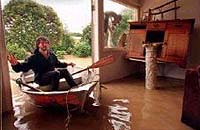
Washington - May 09, 2003 Researchers have discovered how El Nino moves rainfall around the globe and are calling it El Nino's soggy secret. They did so by identifying rainfall patterns in the Pacific Ocean during the life of these periodic climate events, during which waters in the eastern Pacific Ocean warm up. The results may help scientists improve rainfall forecasts around the globe during the life of an El Nino, and they may also offer new insights into how an El Nino develops. The findings are highlighted in a paper by Scott Curtis of the University of Maryland - Baltimore County and Robert F. Adler of NASA's Goddard Space Flight Center in Greenbelt, Maryland. It appears in the Journal of Geophysical Research - Atmospheres, published by the American Geophysical Union. In an effort to predict and understand the effects of El Nino, most scientists have focused on seasonal changes in rainfall patterns, like where and when rain falls during winter. Curtis and Adler take a different approach, looking first at the evolution of rainfall over the Pacific Ocean, which has the power to change the global winds and redirect rainfall patterns around the world. They found a significant pattern of alternating rainfall for El Ninos since 1979, with wetness in eastern China, dryness over Indonesia, and wetness in the south Indian Ocean and Australia. They noted that this pattern swings eastward as El Nino weakens. As it does, rainfall patterns alternate from one area to another. In the eastern Pacific, there is wetness on the Equator, dryness off the coast of Mexico, and wetness off the coast of California. The traditional view of El Nino based on seasonal rainfall patterns obscures these relationships. El Nino events, like individual thunderstorms, differ in intensity, lifespan, rainfall, and other characteristics, making them difficult to quantify. So, Curtis and Adler set parameters to define El Ninos, based on rainfall that occurs in the equatorial Pacific. They looked at the periods before rainfall began, when El Nino started, peaked, and faded, and after it ended. They also identified areas around the globe that were consistently wet or dry during each stage of El Nino. The researchers utilized global rainfall datasets developed from satellites and from rain gauges all over the world, which are part of the Global Precipitation Climatology Project under the Global Energy and Water Cycle Experiment (GEWEX), a project heavily supported by NASA. Data from the Tropical Rainfall Measuring Mission (TRMM) satellite, which were used in this study, will also help ensure the accuracy of satellites used by the National Oceanic and Atmospheric Administration (NOAA) and Department of Defense. TRMM is a joint NASA/Japanese Space Agency mission to study tropical rainfall and its implications for climate. Each day, TRMM observes the Earth's equatorial and tropical regions. In the future, this kind of study may help pinpoint where an El Nino will generate floods, droughts, and changes in rainfall around the globe. Community Email This Article Comment On This Article Related Links SpaceDaily Search SpaceDaily Subscribe To SpaceDaily Express Weather News at TerraDaily.com
 MSG2 Will Advance Long Term Monitoring Of Planetary Energy Balance
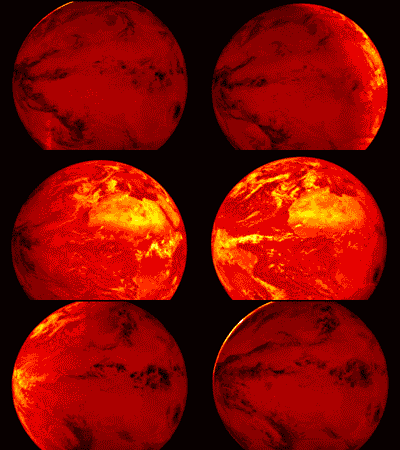 London UK (SPX) Dec 23, 2005
This week's launch of MSG-2 will ensure that satellite images continue to be available to European weather forecasters well into the next decade. It also marks a new chapter in a long-term space experiment measuring the available energy that drives the weather as a whole, and helping to establish how much the Earth is heating up. |
|
|

| The content herein, unless otherwise known to be public domain, are Copyright 1995-2006 - SpaceDaily.AFP and UPI Wire Stories are copyright Agence France-Presse and United Press International. ESA PortalReports are copyright European Space Agency. All NASA sourced material is public domain. Additionalcopyrights may apply in whole or part to other bona fide parties. Advertising does not imply endorsement,agreement or approval of any opinions, statements or information provided by SpaceDaily on any Web page published or hosted by SpaceDaily. Privacy Statement |