|
 |
 |
 |
 |
 |
 |
 |
 |

 |
Einstein@Home Goes Live In Search For Gravitational Waves
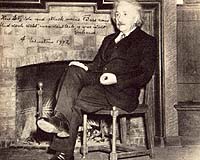
Washington DC (SPX) Feb 21, 2005 A new grassroots computing project dubbed Einstein@Home, which will let anyone with a personal computer contribute to cutting edge astrophysics research, was officially launched at the annual meeting of the American Association for the Advancement of Science (AAAS) in Washington DC on Saturday, February 19. Einstein@Home is a flagship program of the World Year of Physics 2005 celebration of the centennial of Albert Einstein's miraculous year. The program searches for gravitational waves in data collected by US and European gravitational wave detectors. Albert Einstein's General Theory of Relativity predicted the existence of gravitational waves in 1916, but only now has technology reached the point that scientists hope to detect them directly. Gravitational waves are ripples in the fabric of space and time produced by violent events in the universe such as black hole collisions and exploding stars (supernovae). Longer-lived sources of gravitational waves include rapidly rotating compact stars, and binary systems composed of two orbiting stars. The ripples travel through space, carrying information both about their source and about the nature of gravity itself. Einstein@Home searches data from the US Laser Interferometer Gravitational wave Observatory (LIGO) and the British/German GEO-600 gravitational wave observatory for signals coming from very dense, rapidly rotating compact quark and neutron stars. Einstein's theory predicts that if these compact stars are not perfectly spherical, they should continuously emit gravitational waves. LIGO and GEO-600 are now sufficiently sensitive that they might detect these signals if the stars are close enough to earth. Finding such signals in gravitational wave data requires an enormous amount of computing power. Estimates indicate that searching gravitational data with the maximum possible sensitivity would require many times the computing capacity of even the most powerful supercomputer. Therefore, LIGO Scientific Collaboration researchers from the Albert Einstein Institute, UWM, and the LIGO Laboratory are enlisting the aid of an army of home computer users to analyze the data. Much like the popular SETI@Home project that searches radio telescope data for signs of extraterrestrial life, Einstein@Home will involve hundreds of thousands people who will dedicate a portion of their personal computers' computational time to the project. The Einstein@Home program is available for PCs running Windows, Linux, and Mac operating systems. When the computer is not in use, it downloads LIGO and GEO600 data from a central server and searches it for gravitational wave signals. While running, it displays a screensaver that depicts the celestial sphere, with the major constellations outlined. A moving marker indicates the portion of the sky currently being searched on the computer. Community Email This Article Comment On This Article Related Links Einstein@Home World Year of Physics American Physical Society SpaceDaily Search SpaceDaily Subscribe To SpaceDaily Express Understanding Time and Space
 Unified Physics Theory Explains Animals Running Flying And Swimming
 Durham NC (SPX) Jan 05, 2006
A single unifying physics theory can essentially describe how animals of every ilk, from flying insects to fish, get around, researchers at Duke University's Pratt School of Engineering and Pennsylvania State University have found. The team reports that all animals bear the same stamp of physics in their design. |
|
|

| The content herein, unless otherwise known to be public domain, are Copyright 1995-2006 - SpaceDaily.AFP and UPI Wire Stories are copyright Agence France-Presse and United Press International. ESA PortalReports are copyright European Space Agency. All NASA sourced material is public domain. Additionalcopyrights may apply in whole or part to other bona fide parties. Advertising does not imply endorsement,agreement or approval of any opinions, statements or information provided by SpaceDaily on any Web page published or hosted by SpaceDaily. Privacy Statement |