|
 |
 |
 |
 |
 |
 |
 |
 |

 |
Edwards SPADS Keeps An Eye On SpaceShipOne During X Prize Flights
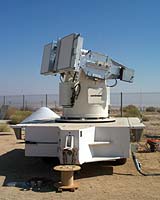
Edwards AFB (SPX) Oct 13, 2004 As SpaceShipOne rocketed through the skies over the Mojave Desert Monday to claim the famed X Prize, a team of engineers here successfully followed the contrails and collected data about the spacecraft's trajectory thanks to an invaluable radar capability known as SPADS, Spaceport Arrival and Departure Safety System. A partnership between the California Space Authority and the Air Force Flight Test Center, SPADS performed its first two technology demonstrations during SpaceShipOne's historic flights Sept. 29 and again Monday. The California Space Authority, whose purpose is to retain, grow and create California space enterprise, and the AFFTC both recognized a need for a multifrequency, continuous wave radar system that can track multiple objects at the same time. In an era of skies crowded with commercial aircraft, and now space planes, SPADS offers a new potential for enhanced safety. For the center, this technology could provide an important range asset for many programs, including monitoring unmanned aerial vehicles, bomb drops and possibly the space shuttle, said Allen Khosrowabadi, SPADS program manager for the 412th Test Wing Program Management Directorate, Acquisition Portfolio. "We can take a product like this to a place on the other side of the lakebed called PIRA, or precision impact range," said Robert Selbrede, JT3 lead engineer, "and set it up, so the aspect angles are the way we want them to be when they drop the bombs. Then (the aircraft) will fly by and drop a whole load of bombs, and this radar can actually see all the individual bombs, see them spin, see the fins come out, the whole works. That's really where something like this excels." Mr. Selbrede continued, "Think of SpaceShipOne as a bomb separating from the aircraft," he said. "You would want to know if the bomb came back up and hit the plane. You would want to see if it came off and dropped off real quick or if it stayed parallel or started tumbling right away." The key component for the SPADS project is the Weibel Doppler radar system, manufactured by Weibel Scientific headquartered in Denmark. It tracks velocity differences as objects move toward or away from the radar's scope, Khosrawabadi explained. "Everything in the beam with a velocity component will be detected," said Edwin Rutkowski, lead SPADS systems engineer for Space Information Laboratories, or SIL, a subcontractor for JT3. "The velocity sets up the Doppler shift frequency return, and that's what the receiver detects. It detects changes in frequency, or the Doppler effect, and computes the range for each one of those." The Weibel radar, which includes one panel for transmitting and another for receiving, sits on a mobile KTM, or kineto tracking mount, which is actually 15- to 20-year-old technology. Engineers with JT3, the range operations and maintenance contractor for the 412th TW, installed the radar and modified the KTM to accept the system. "We retrofitted a slip ring assembly into it, which allows it to turn 360 degrees without wrapping up any of the cables inside," said Jonathan Denning, JT3 field engineer. "There's a cooling system that pumps fluid into the transmit antenna to keep it cool while it is radiating power." JT3 also added a power supply and a camera for the optical tracker. During the SPADS demonstrations, Mr. Denning operated the optical tracker for the KTM from the control trailer as Chris Townsend, SIL systems engineer, collected data from White Knight, SpaceShipOne and other chase aircraft using the Weibel Remote Tracking System software. Mr. Khosrawabadi said it was great to see the whole thing come together. The team had many obstacles to overcome especially in dealing with old and new technologies trying to communicate coherently within the same system. In this first phase of development, Mr. Khosrawabadi explained, the team simply "wanted to get the radar, get familiar with it, and do a demonstration to see if it makes sense for the business the center has or the range has for this specific capability. Apparently now the answer is yes." In the future, the SPADS team plans to update the radar's auto-track feature so that the system does not have to rely on an individual using visual tracking alone. "Then the next step is to make this an operational system by doing the upgrades and getting a bigger radar," Mr. Khosrawabadi said. "The long-term vision, once hypersonic [flight] starts happening, is to increase our range by having a couple of these strung along miles apart. When one loses visual, another one picks it up. As far as the data is concerned, you won't see any holes in it." Community Email This Article Comment On This Article Related Links SpaceDaily Search SpaceDaily Subscribe To SpaceDaily Express Space Tourism, Space Transport and Space Exploration News
 Space Race 2: The Feds Weigh In
 Cape Canaveral FL (UPI) Jan 11, 2005
The Bush administration, with little fanfare, last week unveiled the first update in a decade to the country's official space transportation policy. |
|
|

| The content herein, unless otherwise known to be public domain, are Copyright 1995-2006 - SpaceDaily.AFP and UPI Wire Stories are copyright Agence France-Presse and United Press International. ESA PortalReports are copyright European Space Agency. All NASA sourced material is public domain. Additionalcopyrights may apply in whole or part to other bona fide parties. Advertising does not imply endorsement,agreement or approval of any opinions, statements or information provided by SpaceDaily on any Web page published or hosted by SpaceDaily. Privacy Statement |