|
 |
 |
 |
 |
 |
 |
 |
 |

 |
Eat To Live: Celebrating The Popsicle
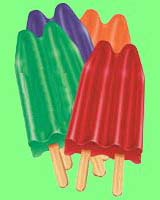
Washington DC (UPI) July 20, 2005 Let's hear it for Frank Epperson. One hundred years ago, in 1905, when he was a mere slip of a boy of 11, he invented the popsicle. As with many famous inventions, Epperson's started with an accidental discovery: One night, he left his fruit-flavored soda outside on the porch of his San Francisco home with a stir stick in it. Overnight, the temperature dropped suddenly and the drink froze. In the morning, Eureka! Frank christened the flavored ice on a stick the Epsicle, but not until 1923, when he was 29, did he apply for a patent for a "frozen ice on a stick" called the Epsicle ice pop. His children renamed it the Popsicle. Two years later, he sold his invention to the Joe Lowe Company of New York City. Good Humor now owns the rights. The family must be happy. The U.S. market for ice creams and frozen desserts totaled over $20 billion in 2001. Americans eat more ice cream annually than any other nation - around 5.63 gallons a head. Vanilla is the top flavor, with chocolate, vanilla with chocolate, fruit, and cookies and cream following swiftly behind. Savvy mothers know they must be firm about popsicles. Children dragging around in the heat easily persuade themselves that a lump of highly sugared juice on a stick is the answer to their soaring temperature, but anyone living on the Indian subcontinent thinks that is nonsense. Over there, the way to stay cool is to drink copious amounts of hot tea, the more to make you sweat and attract any random breezes to the dampened skin. Popsicles, so quickly demolished, are kind neither to the weight nor to the teeth. Nevertheless, only a killjoy would expect to go through summer without enjoying frozen treats. The trick is to pay attention to labeling. Some desserts are less calorie-packed than others. On the other hand, making them at home allows you to control the amount of sweetness and the size of the portion. The first bite of anything always tastes the best. Large portions are not more satisfying to the taste buds than small portions. They are just more soothing to the psyche. You can make six good and creamy popsicles with low calorie content from yogurt: - Blend 3 cups of plain non-fat yogurt with 1 cup of fresh strawberries and 1 tablespoon superfine sugar. - Put 6 paper cups into a muffin tray and pour in the yogurt almost to the top. - Freeze about 30 minutes until slushy, then push a wooden stick into each center. Freeze again until solid, then peel off the paper. As an alternative, drain yogurt by lining a sieve with a paper towel until it becomes fairly solid (reserving the resulting liquid in case you need to loosen the curd). Beat it smooth, add 2 tablespoons of superfine sugar and 1 tablespoon vanilla extract and beat till shiny. In a separate bowl, whisk three egg whites until firm and fold into the yogurt mixture. Then proceed to make vanilla popsicles according to the previous recipe. Make fruit granitas by freezing freshly squeezed orange juice in a shallow freezer-going dish. Every 45 minutes, until you have a fully-frozen slush, lightly beat the mix with a fork, then serve in wine glasses. This can be done with any fruit juice created by pureeing fresh fruit in a blender. Try cubes of melon or watermelon slid onto wooden kebab skewers and frozen for another cooling treat. Community Email This Article Comment On This Article Related Links SpaceDaily Search SpaceDaily Subscribe To SpaceDaily Express Nuclear Space Technology at Space-Travel.com
 Rewriting Glacial History In Pacific North America
 Edmonton AB (SPX) Jan 10, 2006
Although the story on glacier fluctuations in northwestern North America over the last 10,000 years has remained largely unchanged for decades, new evidence discovered by a University of Alberta researcher will rewrite that glacial history and offer clues about our climate history during the last several thousand years. |
|
|

| The content herein, unless otherwise known to be public domain, are Copyright 1995-2006 - SpaceDaily.AFP and UPI Wire Stories are copyright Agence France-Presse and United Press International. ESA PortalReports are copyright European Space Agency. All NASA sourced material is public domain. Additionalcopyrights may apply in whole or part to other bona fide parties. Advertising does not imply endorsement,agreement or approval of any opinions, statements or information provided by SpaceDaily on any Web page published or hosted by SpaceDaily. Privacy Statement |