|
 |
 |
 |
 |
 |
 |
 |
 |

 |
Earth's Inconstant Magnetic Field
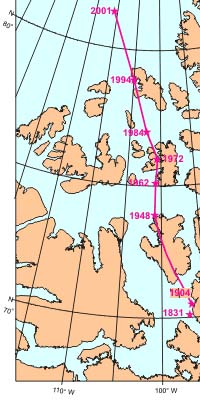
Huntsville - Dec 30, 2003 Every few years, scientist Larry Newitt of the Geological Survey of Canada goes hunting. He grabs his gloves, parka, a fancy compass, hops on a plane and flies out over the Canadian arctic. Not much stirs among the scattered islands and sea ice, but Newitt's prey is there--always moving, shifting, elusive. His quarry is Earth's north magnetic pole. At the moment it's located in northern Canada, about 600 km from the nearest town: Resolute Bay, population 300, where a popular T-shirt reads "Resolute Bay isn't the end of the world, but you can see it from here." Newitt stops there for snacks and supplies--and refuge when the weather gets bad. "Which is often," he says. Scientists have long known that the magnetic pole moves. It was pinpointed first by James Ross in 1831 near the end of a grueling expedition in which his ship got stuck in the ice for four years. Understandably, perhaps, no one returned until the next century. In 1904, Roald Amundsen located the pole again and discovered that it had moved--at least 50 km since the days of Ross. The pole kept going during the 20th century, north at an average speed of 10 km per year, lately accelerating "to 40 km per year," says Newitt. At this rate it will exit North America and reach Siberia in a few decades. Keeping track of the north magnetic pole is Newitt's job. "We usually go out and check its location once every few years," he says. "We'll have to make more trips now that it is moving so quickly." Earth's magnetic field is changing in other ways, too: Compass needles in Africa, for instance, are drifting about 1 degree per decade. And globally the magnetic field has weakened 10% since the 19th century. When this was mentioned by researchers at a recent meeting of the American Geophysical Union, many newspapers carried the story. A typical headline: "Is Earth's magnetic field collapsing?" Probably not. As remarkable as these changes sound, "they're mild compared to what Earth's magnetic field has done in the past," says University of California professor Gary Glatzmaier. Sometimes the field completely flips. The north and the south poles swap places. Such reversals, recorded in the magnetism of ancient rocks, are unpredictable. They come at irregular intervals averaging about 300,000 years; the last one was 780,000 years ago. Are we overdue for another? No one knows. According to Glatzmaier, the ongoing 10% decline doesn't mean that a reversal is imminent. "The field is increasing or decreasing all the time," he says. "We know this from studies of the paleomagnetic record." Earth's present-day magnetic field is, in fact, much stronger than normal. The dipole moment, a measure of the intensity of the magnetic field, is now 8 � 1022 amps � m2. That's twice the million-year average of 4� 1022 amps � m2. To understand what's happening, says Glatzmaier, we have to take a trip ... to the center of the Earth where the magnetic field is produced. At the heart of our planet lies a solid iron ball, about as hot as the surface of the sun. Researchers call it "the inner core." It's really a world within a world. The inner core is 70% as wide as the moon. It spins at its own rate, as much as 0.2� of longitude per year faster than the Earth above it, and it has its own ocean: a very deep layer of liquid iron known as "the outer core." Earth's magnetic field comes from this ocean of iron, which is an electrically conducting fluid in constant motion. Sitting atop the hot inner core, the liquid outer core seethes and roils like water in a pan on a hot stove. The outer core also has "hurricanes"--whirlpools powered by the Coriolis forces of Earth's rotation. These complex motions generate our planet's magnetism through a process called the dynamo effect. Using the equations of magnetohydrodynamics, a branch of physics dealing with conducting fluids and magnetic fields, Glatzmaier and colleague Paul Roberts have created a supercomputer model of Earth's interior. Their software heats the inner core, stirs the metallic ocean above it, then calculates the resulting magnetic field. They run their code for hundreds of thousands of simulated years and watch what happens. What they see mimics the real Earth: The magnetic field waxes and wanes, poles drift and, occasionally, flip. Change is normal, they've learned. And no wonder. The source of the field, the outer core, is itself seething, swirling, turbulent. "It's chaotic down there," notes Glatzmaier. The changes we detect on our planet's surface are a sign of that inner chaos. They've also learned what happens during a magnetic flip. Reversals take a few thousand years to complete, and during that time--contrary to popular belief--the magnetic field does not vanish. "It just gets more complicated," says Glatzmaier. Magnetic lines of force near Earth's surface become twisted and tangled, and magnetic poles pop up in unaccustomed places. A south magnetic pole might emerge over Africa, for instance, or a north pole over Tahiti. Weird. But it's still a planetary magnetic field, and it still protects us from space radiation and solar storms. And, as a bonus, Tahiti could be a great place to see the Northern Lights. In such a time, Larry Newitt's job would be different. Instead of shivering in Resolute Bay, he could enjoy the warm South Pacific, hopping from island to island, hunting for magnetic poles while auroras danced overhead. Sometimes, maybe, a little change can be a good thing. Community Email This Article Comment On This Article Related Links More Images, Captions and Links SpaceDaily Search SpaceDaily Subscribe To SpaceDaily Express Dirt, rocks and all the stuff we stand on firmly
 Magnetic Reconnection Region Larger Than 2.5 Million Km Found In The Solar Wind
 Paris (ESA) Jan 12, 2006
Using the ESA Cluster spacecraft and the NASA Wind and ACE satellites, a team of American and European scientists have discovered the largest jets of particles created between the Earth and the Sun by magnetic reconnection. This result makes the cover of this week's issue of Nature. |
|
|

| The content herein, unless otherwise known to be public domain, are Copyright 1995-2006 - SpaceDaily.AFP and UPI Wire Stories are copyright Agence France-Presse and United Press International. ESA PortalReports are copyright European Space Agency. All NASA sourced material is public domain. Additionalcopyrights may apply in whole or part to other bona fide parties. Advertising does not imply endorsement,agreement or approval of any opinions, statements or information provided by SpaceDaily on any Web page published or hosted by SpaceDaily. Privacy Statement |