|
 |
 |
 |
 |
 |
 |
 |
 |

 |
Earth's Core Rotates Faster Than Its Crust, Scientists Say
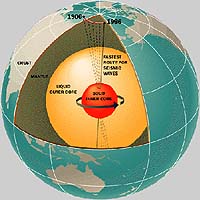
Champaign IL (SPX) Aug 25, 2005 Scientists have ended a 9-year-old debate by proving that Earth's core rotates faster than its surface, by about 0.3 to 0.5 degree per year. "Extraordinary claims require extraordinary proof," said Xiaodong Song, a professor of geology at the University of Illinois at Urbana-Champaign and corresponding author of a paper to appear in the Aug. 26 issue of the journal Science. "We believe we have that proof." Earth's iron core consists of a solid inner core about 2,400 kilometers in diameter and a fluid outer core about 7,000 kilometers in diameter. The inner core plays an important role in the geodynamo that generates Earth's magnetic field, and an electromagnetic torque from the geodynamo is thought to drive the inner core to rotate relative to the mantle and crust. The first observational evidence for differential rotation was presented in 1996 by Song and Paul Richards, a seismologist at the Lamont-Doherty Earth Observatory of Columbia University. For the past nine years, some seismologists have suspected that flaws, or artifacts, in the data were responsible for the purported movement. By comparing historical seismic waves traversing Earth's fluid and solid cores, Song and his colleagues found compelling evidence for differential rotation of the solid inner core. The researchers reported observations of 17 sets of similar seismic waves � called waveform doublets � from earthquakes occurring in the South Sandwich Islands region off the coast of South America. The doublets, which were recorded at up to 58 seismic stations in and near Alaska with a time separation of up to 35 years, allowed the researchers to detect temporal changes along the sampling paths. "The similar seismic waves that passed through the inner core show systematic changes in travel times and wave shapes when the two events of the doublet are separated in time by several years," Song said. "The only plausible explanation is a motion of the inner core." The most likely explanation for why the inner core is rotating at a different speed, Song said, is electromagnetic coupling. "The magnetic field generated in the outer core diffuses into the inner core, where it generates an electric current. The interaction of that electric current with the magnetic field causes the inner core to spin, like the armature in an electric motor." The fluid outer core decouples the solid inner core's movement from the mantle. Because the fluid outer core is not very viscous, frictional drag is small. "Differential rotation is a fundamental dynamic process that goes to the heart of the origin of our planet and how it has evolved," Song said. "There is still much to learn about the inner Earth." In addition to Song and Richards, co-authors are Illinois graduate students Yingchun Li and Xinlei Sun and Columbia graduate student Jian Zhang and research scientist Felix Waldhauser. The work was funded by the U.S. National Science Foundation and the Natural Science Foundation of China. Community Email This Article Comment On This Article Related Links University of Illinois at Urbana-Champaign SpaceDaily Search SpaceDaily Subscribe To SpaceDaily Express Dirt, rocks and all the stuff we stand on firmly
 Magnetic Reconnection Region Larger Than 2.5 Million Km Found In The Solar Wind
 Paris (ESA) Jan 12, 2006
Using the ESA Cluster spacecraft and the NASA Wind and ACE satellites, a team of American and European scientists have discovered the largest jets of particles created between the Earth and the Sun by magnetic reconnection. This result makes the cover of this week's issue of Nature. |
|
|

| The content herein, unless otherwise known to be public domain, are Copyright 1995-2006 - SpaceDaily.AFP and UPI Wire Stories are copyright Agence France-Presse and United Press International. ESA PortalReports are copyright European Space Agency. All NASA sourced material is public domain. Additionalcopyrights may apply in whole or part to other bona fide parties. Advertising does not imply endorsement,agreement or approval of any opinions, statements or information provided by SpaceDaily on any Web page published or hosted by SpaceDaily. Privacy Statement |