|
 |
 |
 |
 |
 |
 |
 |
 |

 |
Earthquake 'Pulses' Could Predict Tsunami Impact
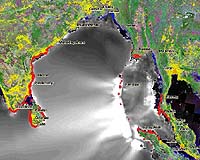
Corvallis OR (SPX) Dec 03, 2005 The magnitude 9.2 earthquake that triggered a devastating tsunami in the Indian Ocean in December of 2004 originated just off the coast of northern Sumatra, but an "energy pulse" � an area where slip on the fault was much greater � created the largest waves, some 100 miles from the epicenter. Seismologists have mapped these energy pulses for Sumatra and are trying to learn more about them to predict better when and where tsunamis may occur. They also hope these pulses will help them gain a more comprehensive understanding of the earthquake history of the Cascadia Subduction Zone off the Pacific Northwest Coast of the United States. "Understanding the nature of these pulses could be critical because it could mean the difference between 15 minutes and 30 minutes in a tsunami warning," said Chris Goldfinger, an associate professor in the College of Oceanic and Atmospheric Sciences at Oregon State University and one of the leading experts in the world on the Cascadia fault zone. "It seems that the largest Cascadia earthquakes have three pulses," Goldfinger added, "and core data show that more than half of the earthquakes in the Cascadia Subduction Zone are of this large type that appear to generate three rupture sequences." Earthquake "pulses" are releases of energy from areas of high slip along the main fault. When a subduction zone earthquake occurs, the tectonic plates that have locked for centuries suddenly release. An area of ocean floor that may be as wide as 50 miles, and as long as 500 to 600 miles, can suddenly snap back, causing a massive tsunami. As that energy radiates down the fault, it is concentrated in certain areas, Goldfinger said. The severity of the tsunami in any locality depends on how much energy is released, and what the undersea terrain is like. The energy pulses, which are part of the earthquake sequence and take place almost immediately, differ from aftershocks that may occur hours, days, weeks or months after the original earthquake. In fact, the December Sumatra quake was followed by an 8.7 tremor in March and, though it occurred well to the south, "looks to have been directly triggered by the stress of the December event," Goldfinger said. "And there have been a lot of aftershocks since," he added. Goldfinger said it appears the Indian Ocean fault is rupturing in a southerly direction and that Padang, the capital of West Sumatra, may be next in line for a major earthquake. But whether that quake takes place in weeks or years remains to be seen. Though Padang's last major quake was about 200 years ago, the increased stress on the fault makes it likely that the lag between events will be much shorter. "When you load the stress on a fault, it shortens the time between quakes," Goldfinger pointed out. "It's like putting a sheet of glass between two sawhorses � and then sticking a cinder block in the middle of the glass. It may not break right away, but the stress builds rapidly." Comparatively little is known about the long-term tectonic history of the Indian Ocean � at least, compared to the Cascadia Subduction Zone, scientists say. Goldfinger has been able to identify 23 major earthquakes off the Pacific Northwest coast during the past 10,000 years through analysis of sediment deposits. At least 16, and possibly 17, of those quakes have ruptured along the entire length of the Cascadia Subduction Zone, requiring an event of magnitude 8.5 or better. When a major offshore earthquake of that magnitude occurs, "you get ground acceleration of a couple of G's," Goldfinger pointed out. "Mud and sand begin streaming down the continental margins, and out into the undersea canyons. Walls fail. And the sediments run out into the abyssal plain. The impact is much, much greater than you can get from any storm � or even a small magnitude quake." Those coarse sediments � called turbidites � stand out from the finer particulates that accumulate on a surprisingly regular basis in between major tectonic events. By studying core samples from submarine channels in various locations along the subduction zone, Goldfinger and his colleagues have been able to create a 10,000-year timeline of huge earthquakes that provide sobering evidence that the Northwest is due for a major event. Going back farther than 10,000 years is proving to be difficult. "The sea level used to be lower and rivers emptied directly into offshore canyons," he said. "You couldn't differentiate between storms and earthquakes. But once sea levels rose, the river sediments were trapped on the shelf and upper slope, leaving a near-perfect earthquake record farther out." Goldfinger said that evidence suggests turbidites might record earthquake pulses, but more testing is needed in Sumatra, where "we have good recordings of the earthquake." What the Indian Ocean lacks is the same long-term sediment analysis that has been done in the Cascadia zone, says Goldfinger, who adds that conditions there are ideal for such research. He and a team of scientists from Indonesia and India are planning a series of cruises over the next several years to take core samples from the Indian Ocean in an attempt to map the tectonic history of the region. "If anything, the Indian Ocean is even better suited than Cascadia for this kind of core analysis because there is a huge basin between the rivers and the deep ocean that keeps the terrestrial sediments close to land," Goldfinger said. "We should clearly be able to see the December and March turbidites stacked on top of the finer sediments." Community Email This Article Comment On This Article Related Links Oregon State University SpaceDaily Search SpaceDaily Subscribe To SpaceDaily Express Tectonic Science and News
 Ash Continuing To Spew From Vanuatu Volcano
 Sydney (AFP) Dec 12, 2005
Thousands of tonnes of ash are continuing to spew from a volcano in Vanuatu, but officials said Monday the activity on the South Pacific nation was not likely to result in a major deadly eruption. |
|
|

| The content herein, unless otherwise known to be public domain, are Copyright 1995-2006 - SpaceDaily.AFP and UPI Wire Stories are copyright Agence France-Presse and United Press International. ESA PortalReports are copyright European Space Agency. All NASA sourced material is public domain. Additionalcopyrights may apply in whole or part to other bona fide parties. Advertising does not imply endorsement,agreement or approval of any opinions, statements or information provided by SpaceDaily on any Web page published or hosted by SpaceDaily. Privacy Statement |