|
 |
 |
 |
 |
 |
 |
 |
 |

 |
Earth-Shattering Proof Of Continents On The Move
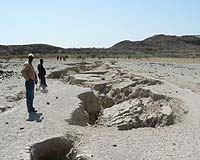
Leeds, UK (SPX) Jan 30, 2007 Africa is being torn apart. And as Ethiopia's rift valley grows slowly wider, an international team of scientists is taking a unique opportunity to plot the progress of continents on the move. The 28-strong team is led by University of Leeds geophysicist Dr Tim Wright, who has secured a pound2.5 million grant from the Natural Environment Research Council (NERC) to study the seismic events taking place in the remote Afar desert of Northern Ethiopia. It's here that two mighty shelves of continental crust, the African and Arabian plates, meet - and are tearing the landscape apart. For most of the time, this happens at around the same speed that human fingernails grow - about 16mm a year. But the gradual build-up of underground pressure can lead to occasional bursts of cataclysmic activity. The most dramatic event came in September 2005, when hundreds of deep crevices appeared within a few weeks, and parts of the ground shifted eight metres, almost overnight. More than two billion cubic metres of rising molten rock - magma - had seeped into a crack between the African and Arabian tectonic plates, forcing them further apart. And it has given Dr Wright's team a unique opportunity to witness plate tectonics - the science of how continents are formed and move - at first hand. "Much of the activity between the continental shelves takes place deep underwater at the mid-ocean ridges. Ethiopia is the only place on the planet where we can see a continent splitting apart on dry land." Dr Wright and his colleagues will use satellite radar imaging to measure how the ground deforms. "In its simplest form, you are taking two snapshots of the same place, separated by a period of time, to see how far they have moved apart." His team, which includes experts from Oxford, Cambridge, Bristol and Edinburgh universities, as well as international researchers from the US, New Zealand, France and Ethiopia, will also use GPS, seismometers, and other geophysical and geochemical techniques to determine the properties of rock and magma below the surface, and to monitor the crust's movement. They will use the data to create a 3D computer model of how magma moves through the Earth's crust to make and break continents. As the sides of the Ethiopian rift move apart, the gap between them is being plugged with molten rock, which then cools to form new land. And in around one million year's time the Red Sea could come flooding into the sinking region, re-shaping the map of Africa forever. "It's very exciting because we're witnessing the birth of a new ocean," said Dr Wright. "In geological terms, a million years is the blink of an eye. We don't precisely know what is going to happen, but we believe that it may turn parts of Northern Ethiopia and Eritrea into an island, before a much larger land mass - the horn of Africa - breaks off from the continent." Much of the team's work will be on the ground in the Afar region of Ethiopia, also known as the Danakil depression. It's a barren, inhospitable, but beautiful part of the world. "Afdera, one of the towns in the region, is the hottest continuously-occupied place on the planet," said Dr Wright. "Temperatures can approach 60 degrees centigrade during the summer months, so we tend to go in the winter when it's that bit cooler - although it still gets to 45C." Scientists from the University of Addis Ababa who are working on the project will undertake collaborative research visits to the UK. The research will establish a firm link between the two universities, with Leeds supporting two Ethiopian students on a PhD programme which will include a year in the UK. "We will be training Ethiopian scientists in the use of satellite and radar technology - skills they will be able to continue to use long after this programme has ended." Community Email This Article Comment On This Article Related Links University of Leeds When the Earth Quakes Tectonic Science and News
 First Comprehensive Caribbean Earthquake Model
 Fayetteville AK (SPX) Dec 27, 2006
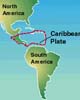
Researchers at the University of Arkansas and Purdue University have monitored tiny tectonic movements in the Caribbean to create the first comprehensive and quantitative kinematic model describing potential earthquake activity in the region. University of Arkansas researchers Pamela Jansma and Glen Mattioli, together with Purdue University researchers D. Manaker and Eric Calais, presented their findings at the fall meeting of the American Geophysical Union. |
|
|

| The content herein, unless otherwise known to be public domain, are Copyright 1995-2006 - SpaceDaily.AFP and UPI Wire Stories are copyright Agence France-Presse and United Press International. ESA PortalReports are copyright European Space Agency. All NASA sourced material is public domain. Additionalcopyrights may apply in whole or part to other bona fide parties. Advertising does not imply endorsement,agreement or approval of any opinions, statements or information provided by SpaceDaily on any Web page published or hosted by SpaceDaily. Privacy Statement |