
 |
 |
 |
 |
 |
 |
 |
 |
 |

 |
Earth Physics Is Probably A Universal Thing
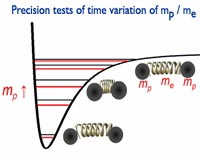
Bonn, Germany (SPX) Jun 24, 2008 The laws of nature are the same in the distant Universe as they are here on Earth, according to new research conducted by an international team of astronomers, including Christian Henkel from the Max Planck Institute for Radio Astronomy (MPIfR) in Bonn. Their research, published June 20 in Science, shows that one of the most important numbers in physics theory, the proton-electron mass ratio, is almost exactly the same in a galaxy 6 billion light years away as it is in Earth's laboratories - approximately 1836.15. According to Michael Murphy, Swinburne astrophysicist and lead author of the study, it is an important finding, as many scientists debate whether the laws of nature may change at different times and in different places in the Universe. "We have been able to show that the laws of physics are the same in this galaxy half way across the visible Universe as they are here on Earth," he said. The astronomers determined this by effectively looking back in time at a distant quasar, labelled B0218+367. The quasar's light, which took 7.5 billion years to reach us, was partially absorbed by ammonia gas in an intervening galaxy. Not only is ammonia useful in most bathroom cleaning products, it is also an ideal molecule to test our understanding of physics in the distant Universe. Spectroscopic observations of the ammonia molecule were performed with the Effelsberg 100m radio telescope at 2 cm wavelength (red-shifted from the original wavelength of 1.3 cm). The wavelengths at which ammonia absorbs radio energy from the quasar are sensitive to this special nuclear physics number, the proton-electron mass ratio. "By comparing the ammonia absorption with that of other molecules, we were able to determine the value of the proton-electron mass ratio in this galaxy, and confirm that it is the same as it is on Earth," says Christian Henkel from MPIfR, an expert for molecular spectroscopy and co-author of the study. The astronomers' aim is to continue testing the laws of nature in as many different places and times in the Universe as possible, in order to see how well the laws of nature stand up in untested situations. They will need to locate more absorbing galaxies. The studied galaxy, B0218+367, is the only target for this kind of research so far. There must be many more target galaxies out there, as soon as the right telescopes to find them are available. According to Murphy, this problem could be overcome with the proposed Square Kilometre Array (SKA) telescope project. "The SKA is the largest, most ambitious international telescope project ever conceived. When completed it will have an enormous collecting area, and will allow us to search for more absorbing galaxies." The location of the SKA, which has been short-listed to Western Australia or Southern Africa, will be announced within the next two years. By continuing their research into the forces of nature, the astronomers also hope to find a window into the extra dimensions of space that many theoretical physicists think may exist. Original Paper: Strong Limit on a Variable Proton-to-Electron Mass Ratio from Molecules in the Distant Universe, Michael T. Murphy, Victor V. Flambaum, Sebastien Muller, Christian Henkel, Science, 2008, June 20 issue. Community Email This Article Comment On This Article Share This Article With Planet Earth
Related Links Weblink with Figures and additional references Understanding Time and Space
 Finding Out What The Big Bang And Ink Jets Have In Common
 Paris, France (SPX) Jun 11, 2008
It often turns out there is more to commonplace everyday events than meets the eye. The folding of paper, or fall of water droplets from a tap, are two such events, both of which involve the creation of singularities requiring sophisticated mathematical techniques to describe, analyse and predict. |
|
|

| The content herein, unless otherwise known to be public domain, are Copyright 1995-2007 - SpaceDaily.AFP and UPI Wire Stories are copyright Agence France-Presse and United Press International. ESA Portal Reports are copyright European Space Agency. All NASA sourced material is public domain. Additional copyrights may apply in whole or part to other bona fide parties. Advertising does not imply endorsement,agreement or approval of any opinions, statements or information provided by SpaceDaily on any Web page published or hosted by SpaceDaily. Privacy Statement |
 del.icio.us
 Digg
Digg Reddit
 YahooMyWeb
 Google
 Facebook