|
 |
 |
 |
 |
 |
 |
 |
 |

 |
Earth Lights Up As Sun Explodes With Multiple CMEs
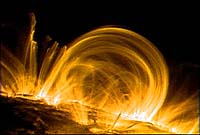
Greenbelt MD (SPX) Nov 15, 2004 Millions of people around the world were treated to a brilliant display of aurora lights this week. The Sun produced at least five major "halo" coronal mass ejections (CMEs) over the period of Nov. 4-8, an unusually fast pace for solar activity. A "halo" CME occurs when a CME produces an expanding circle of particles all around the Sun. When observers see this they know the CME is heading directly towards or away from Earth. In this case, all were headed in our direction, bringing the auroral light show with them. The source of storms was a group of sunspots called Active Region 696. The area also produced powerful solar explosions called flares. The most significant solar storm occurred late on Nov. 5th (Universal Time). The aurora, also known as the Northern and Southern Lights, form when solar particles and magnetic fields pump energy into the Earth's magnetic field, accelerating electrically charged particles trapped within. The high-speed particles crash into Earth's upper atmosphere (ionosphere) over the polar regions, causing the atmosphere to emit a ghostly, multicolored glow. More solar storms may well impact Earth at least for several more days. This kind of solar activity is getting increasingly rare as we enter into the quiet period of the Sun's eleven-year cycle of activity. The years 2000-2001 marked the highest point of activity, but that doesn't preclude the occasional surprise like this week's CMEs. Even more significant were the intense solar storms that raged about a year ago. Community Email This Article Comment On This Article Related Links Exploratorium's Aurora Site Sun-Earth Viewer SpaceDaily Search SpaceDaily Subscribe To SpaceDaily Express Solar Science News at SpaceDaily
 Intrepid Solar Spacecraft Celebrates 10th Anniversary
 Greenbelt MD (SPX) Nov 30, 2005
The Solar and Heliospheric Observatory (SOHO) spacecraft celebrates its 10th anniversary on December 2. The SOHO mission, a collaboration between NASA and the European Space Agency, has allowed scientists to make significant advances in understanding Earth's closest star, our sun. |
|
|

| The content herein, unless otherwise known to be public domain, are Copyright 1995-2006 - SpaceDaily.AFP and UPI Wire Stories are copyright Agence France-Presse and United Press International. ESA PortalReports are copyright European Space Agency. All NASA sourced material is public domain. Additionalcopyrights may apply in whole or part to other bona fide parties. Advertising does not imply endorsement,agreement or approval of any opinions, statements or information provided by SpaceDaily on any Web page published or hosted by SpaceDaily. Privacy Statement |