|
 |
 |
 |
 |
 |
 |
 |
 |

 |
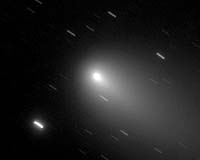
Earth-Grazing Comet Continues Its Breakup
Pasadena CA (SPX) Apr 27, 2006 Periodic comet 73P/Schwassmann-Wachmann 3 has now broken into more than 30 different pieces as it approaches the Sun, scientists at NASA's Jet Propulsion Laboratory report. The comet, discovered May 2, 1930, by Arnold Schwassmann and Arno Wachmann at the Hamburg Observatory in Germany, was the third periodic comet discovered by the pair and the 73rd comet to be recognized as periodic. Because of poor observing conditions, the comet was not recovered during its next return to perihelion in 1935-1936. As a result, calculations of the comet's orbit were rough and its close passes by Jupiter in October 1953, at 0.9 AU, and November 1965, at 0.25 AU, further degraded astronomers' predictions. An Astronomical Unit is about 93 million miles, or the distance between Earth and the Sun. The comet was re-discovered on Aug. 13, 1979, missed during the next return to perihelion in 1985-1986 - again because of poor observing conditions - and then observed during its returns in 1990, 1995-1996, 2000-2001 and the current 2005-2006 encounter. In late 1995, the comet began to break up into fragments. The main comet - now called fragment C - has further split into fragments A and B. In 2001, fragment C was observed along with the fragment B and a new fragment E. During its 2006 return to perihelion, which for fragment C will take place on June 6 - just inside the Earth's orbit - the comet has fragmented into more than 30 additional pieces. All of the observed fragments in 2006 will pass relatively close to Earth between May 12 and May 28, but none will pass closer than 5.5 million miles. Astronomers consider the nearby passes of the fragments an excellent opportunity to examine the cometary breakup process and they hope their observations will improve understanding of why comets disrupt. Apparently some comets have very weak internal structures, and perhaps rapid rotation or the pressure of vaporizing interior ices, as the comet approaches the warming Sun, causes the breakup events. In addition to ongoing ground-based visual observations, the Hubble Space Telescope and the Spitzer infrared space telescope are continuing to monitor the comet. The Arecibo and Goldstone planetary radars will begin their observations on April 30. Community Email This Article Comment On This Article Related Links 73P Information Asteroid and Comet Mission News, Science and Technology
 VLT Takes Images Of Disintegrating Comet P73 Schwassmann-Wachmann 3
 Washington DC (SPX) Apr 26, 2006
On the night of April 23 to 24, ESO's Very Large Telescope observed fragment B of the comet Schwassmann-Wachmann 3 that had split a few days earlier. To their great surprise, the ESO astronomers discovered that the piece just ejected by fragment B was splitting again! Five other mini-comets are also visible on the image. The comet seems thus doomed to disintegrate but the question remains in how much time. |
|
|

| The content herein, unless otherwise known to be public domain, are Copyright 1995-2006 - SpaceDaily.AFP and UPI Wire Stories are copyright Agence France-Presse and United Press International. ESA PortalReports are copyright European Space Agency. All NASA sourced material is public domain. Additionalcopyrights may apply in whole or part to other bona fide parties. Advertising does not imply endorsement,agreement or approval of any opinions, statements or information provided by SpaceDaily on any Web page published or hosted by SpaceDaily. Privacy Statement |