|
 |
 |
 |
 |
 |
 |
 |
 |

 |
Early Universe Was Packed With Mini Black Holes
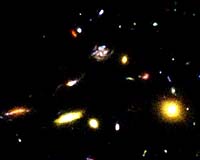
Cambridge, UK (SPX) Apr 14, 2005 A research group at Cambridge think that the universe might once have been packed full of tiny black holes. Dr Martin Haehnelt, a researcher in the group led by Astronomer Royal Martin Rees, will present new evidence to support this controversial idea at the Institute of Physics conference Physics 2005 in Warwick. Most cosmologists believe that supermassive black holes grew up in big galaxies, accumulating mass as time went on. But Haehnelt says there is increasing evidence for a different view � that small black holes grew independently and merged to produce the giants which exist today. Haehnelt points to evidence from recent studies of the cosmic microwave background (CMB). This radiation, sometimes called "the echo of the big bang" has been travelling unaltered through space since the universe was just 400,000 years old. At that moment the universe cooled through a critical point, letting CMB radiation travel freely for the first time � as though a cosmic fog had lifted. But new evidence shows that 10 to 15 percent of this radiation has been scattered since then. This indicates a re-warming of the universe which nobody had expected. Haehnelt explains that this could indicate an era in which small black holes were commonplace. "Matter accreting around a black hole heats up," he explains, "and this heating could be a sign that small black holes were widespread in the Universe at that time." If small black holes merged to form the supermassive variety found at the centres of galaxies, there could be telltale evidence. Such a merger begins with two black holes going into orbit around each other, spiralling ever closer together. In the cataclysmic blast of energy when they finally merge, any asymmetry can send the resulting black hole flying off into space. "If this happened," says Haehnelt, "we might find the occasional galaxy with its central supermassive black hole missing." The evidence is by no means conclusive. Until it is, the CMB results will remain a source of heated debate. Community Email This Article Comment On This Article Related Links Institute of Astronomy at University of Cambridge Institute of Physics SpaceDaily Search SpaceDaily Subscribe To SpaceDaily Express Black Hole Science and News
 MIT: SpInning Black Hole Leaves Dent In Space-Time
 Boston MA (SPX) Jan 12, 2006
MIT scientists and colleagues have found a black hole that has chiseled a remarkably stable indentation in the fabric of space and time, like a dimple in one's favorite spot on the sofa. |
|
|

| The content herein, unless otherwise known to be public domain, are Copyright 1995-2006 - SpaceDaily.AFP and UPI Wire Stories are copyright Agence France-Presse and United Press International. ESA PortalReports are copyright European Space Agency. All NASA sourced material is public domain. Additionalcopyrights may apply in whole or part to other bona fide parties. Advertising does not imply endorsement,agreement or approval of any opinions, statements or information provided by SpaceDaily on any Web page published or hosted by SpaceDaily. Privacy Statement |