|
 |
 |
 |
 |
 |
 |
 |
 |

 |
Earliest Known Bling Revealed
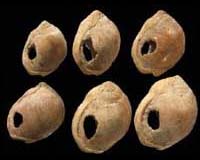
London (SPX) Jun 25, 2006 Fresh analysis of beads made from seashells by a team led by a UCL (University College London) researcher reveals that modern humans used jewellery at least 25,000 years earlier than previously thought. Researchers from the UK, France and Israel report in the journal Science that they re-examined beads, originally excavated from a site in Israel and one in Algeria in the early half of the 20th Century, using elemental and chemical analysis. Results show the beads date from between 100,000 to 135,000 years ago - which is much earlier than a recent significant find of beads excavated in South Africa that date from 75,000 years ago. Personal ornaments, along with art, are generally considered as archaeological proof of an aptitude for symbolic thinking and the findings have major implications for the debates about the origins of behaviourally modern humans. Dr Marian Vanhaeren, of the AHRC Centre for the Evolutionary Analysis of Cultural Behaviour, UCL Institute of Archaeology, and lead author of the study, says: "Symbolically mediated behaviour has emerged as one of the few unchallenged and universally accepted markers of modernity. A key characteristic of all symbols is that their meaning is assigned by arbitrary, socially constructed conventions and it permits the storage and display of information. "The main challenge for paleoanthropology is establishing when in human evolution this ability developed. Archaeological evidence suggests that Anatomically Modern Humans (AMH) from Africa were also behaviourally modern before 40,000 but until now evidence has remained scant. "Given that the same shell species were unearthed at distinct geographical sites suggests that a symbolic tradition extended across the Eastern and Southern Mediterranean. It supports the hypothesis that a widespread tradition of beadwork existed in North Africa and the countries of Western Asia well before the arrival of AMH in Europe." Human remains excavated from Ethiopia demonstrate that Homo sapiens in Africa were anatomically modern 160,000 years ago, but debate continues over when and where humans first became behaviourally modern. In 2004 engraved ochre and Nassarius kraussianus seashell beads bearing human-made perforations and traces of use were discovered at the Blombos Cave, South Africa and were dated to 75,000 years ago. The finding suggests that humans became behaviourally modern much earlier than previously thought but it has been hotly contested because of a lack of corroborating evidence from other sites. The seashell beads that have been re-examined were originally unearthed at a Middle Palaeolithic site at Es-Skhul, Mount Carmel, Israel and from the type-site of the Aterian industry, of Oued Djebbana, Bir-el-Ater, Algeria. The shells from Skhul are currently held in the Department of Palaeontology, Natural History Museum (NHM), London, and the specimen from Oued Djebbana in the Department of Prehistory, Musee de l'Homme, Paris. Remoteness from seashore - up to 200 km in the case of Oued Djebban - and detailed comparison to natural shell assemblages indicates in both cases there was deliberate selection and transportation by humans of Nassarius gibbosulus seashells for symbolic use. Dr Vanhaeren added: "Personal ornaments have many different - and often multiple - functions. They may be used to beautify the body, function as 'love letters' in courtship, or as amulets that express individual or group identity. The function of the oldest beads in Africa and Eurasia were probably different because in the first case we have only one bead type and in the second a rich variety of types. "We think that the African evidence may point to the beads being used in gift-giving systems which function to strengthen social and economic relationships. The European evidence suggests the beads were used as markers of ethnic, social and personal identity." The paper, 'Middle Palaeolithic Shell Beads in Israel and Algeria' will be published in the June 23 edition of the journal Science. The authors are: Marian Vanhaeren (1), Francesco d'Errico (2), Chris Stringer (3), Sarah L. James (4), Jonathan A. Todd (3), Henk K. Mienis (5) Community Email This Article Comment On This Article Related Links University College London All About Human Beings and How We Got To Be Here
 World Slums Set For Huge Growth
 Vancouver, Canada (AFP) Jun 23, 2006
A huge chunk of urban growth around the world will be concentrated in slums that will become a magnet for terrorists and crime, the UN World Urban Forum was warned as it closed Friday. If left unchecked, slums will become "centres of deprivation and instability," Inga Bjork-Klevby, assistant UN secretary general, told one meeting on the future of cities at the forum. |
|
|

| The content herein, unless otherwise known to be public domain, are Copyright 1995-2006 - SpaceDaily.AFP and UPI Wire Stories are copyright Agence France-Presse and United Press International. ESA PortalReports are copyright European Space Agency. All NASA sourced material is public domain. Additionalcopyrights may apply in whole or part to other bona fide parties. Advertising does not imply endorsement,agreement or approval of any opinions, statements or information provided by SpaceDaily on any Web page published or hosted by SpaceDaily. Privacy Statement |