|
 |
 |
 |
 |
 |
 |
 |
 |

 |
Earlier Crop Plantings Could Curb Future Yields
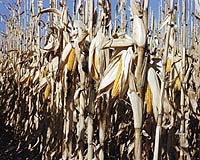
Madison WI (SPX) Oct 06, 2006 In an ongoing bid to grow more corn, farmers in the U.S. Corn Belt are planting seeds much earlier today than they did 30 years ago, a new study has found. Poring over three decades of agricultural records, Christopher Kucharik, an associate scientist at the University of Wisconsin-Madison, discovered that farmers in 12 U.S. states now put corn in the ground around two weeks earlier than they did during the late 1970s. His findings appear in the current issue of the Agronomy Journal. Earlier plantings-which mean longer growing seasons--have likely contributed to the increasing corn yields of recent decades. But Kucharik, a terrestrial ecologist at the UW-Madison's Center for Sustainability and the Global Environment, warns the trend can only continue for so long. "Earlier plantings really can't continue forever because ultimately, farmers will have to contend with wintertime conditions and frozen soils," says Kucharik. "Several decades from now we might see an unexpected drop in annual yield increases when this trend plateaus, which could then increase the threat to our food supply." The Corn Belt is a major agricultural region of the U.S. Midwest, where corn is a dominant crop. Centered in Iowa and Illinois, the belt extends into Wisconsin, Michigan, Minnesota, South Dakota, Nebraska, Kansas, Missouri, Indiana, Ohio and Kentucky. Kucharik had initially set out to explore the wider influence of climate change on agricultural yields. But as he began to work with census data maintained by the U.S. Department of Agriculture, he accidentally noticed that over the decades, farmers have been planting most of their corn crops earlier and earlier in the year. At first, he speculated that the pattern was simply a result of earlier springtime temperatures brought on by global warming. But on probing the last 30 years of the climate record, Kucharik found little proof that warmer weather motivated the early plantings. "There is very weak or little to no correlation with springtime temperatures over the majority of the Corn Belt and these [earlier] planting dates," Kucharik says. Rather, other factors- - such as improved land management practices and advances in biotechnology - have been far more instrumental in the decision to sow seeds earlier from year to year. Farmers now have access to new types of seeds, for instance, that are engineered so that plants are more resistant to the colder soils of early spring. Another technologically enhanced corn seed comes with a polymer coating that only switches "on" when the soil reaches temperatures suitable for seed germination. As technology has continued to revolutionize agricultural methods, farmers have been increasingly confident to put seeds in the ground as soon as they possibly can. But Kucharik says they should be careful, because nature's seasonal clock can only be manipulated so much. "If you start to shift a plant's development too early, it may start to get out of synch with the seasonal climate it is accustomed to," he says. While earlier corn plantings have helped crops grow more plentiful over the years, Kucharik hopes the agricultural community will take note of the continuing trend so that future crop yields don't suddenly fall under the mark. Community Email This Article Comment On This Article Related Links University of Wisconsin-Madison The latest farming technology and science news Farming Today - Suppliers and Technology
 'New world' Vineyards Stealing A March On Europeans In Fast-Growing Market
 Paris (AFP) Oct 05, 2006
Vineyards in the new world and even in China are stealing a march on traditionally dominant European producers in the race to slake the world's fast-growing thirst for wine. From having a market share of just 1.6 percent 20 years ago, wines from countries like Chile, Australia and the United States now have a 25.5 percent slice of the 100 billion dollar (80 billion euro) global market, according to the International Organisation of Vine and Wine (OIV). |
|
|

| The content herein, unless otherwise known to be public domain, are Copyright 1995-2006 - SpaceDaily.AFP and UPI Wire Stories are copyright Agence France-Presse and United Press International. ESA PortalReports are copyright European Space Agency. All NASA sourced material is public domain. Additionalcopyrights may apply in whole or part to other bona fide parties. Advertising does not imply endorsement,agreement or approval of any opinions, statements or information provided by SpaceDaily on any Web page published or hosted by SpaceDaily. Privacy Statement |