|
 |
 |
 |
 |
 |
 |
 |
 |

 |
Eagle Nest Webcam A Huge Hit
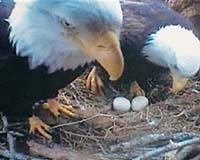
Vancouver, Canada (AFP) May 08, 2006 After the last egg of a suddenly famous family of bald eagles vanished before a worldwide Internet audience, a Canadian conservationist has begun setting up more wildlife Internet cameras. For weeks, a camera pointed at a nest of eagles on Canadas west coast has streamed their life-and-death drama to as many as 10 million Internet watchers each day, becoming one of the worlds most popular websites. "Its absolutely bizarre," said David Hancock, who put the eagle images on line. In a lifetime devoted to nature issues, the 68-year-old biologist and book publisher said he has never seen such a huge audience enthralled with wild animals. The web camera's owner is David Carrick, an accountant who retired 15 years ago on Hornby Island, in Canadas westernmost province of British Columbia. "We had no idea it would catch on like it did," marveled Carrick. An Internet site was the last thing on Carricks mind when he decided he wanted a close-up view of an eagle nest in his back yard. In 2004, while the birds were away on their fall migration, he obtained government permission and had a tree-climber install a small camera beside the nest, connected to Carricks house. The camera, which the birds ignore, provides an intimate view of their aerie. After Carrick shared video recordings of the nest with community, school and naturalist groups, Hancock happened to see them, and offered to put the nest live on the Internet for Carrick. At first the camera, linked from hancockwildlife.org, drew a mere handful of viewers. There were more Internet hits as the pair of bald eagles laid two eggs in late March and spent the next month tending them, and traffic steadily increased. by early May, when one egg mysteriously vanished and the fate of the second hung in the balance, the website's popularity spread like wildfire. The popularity may be due to the mystique surrounding bald eagles, creatures so striking with their white head, piercing yellow eyes and an eight-foot wingspan that the United States made them a national symbol. Bald eagles mate for life, and live as long as 50 years in the wild. But Hancock thinks there is more to it than the birds image. "Were all fighting two jobs, two computers, two careers and half enough time to deal with any of them," said Hancock. "And there, sitting on your desktop computer, is this bird that doesnt give a damn about it all, but just gets up and rolls its eggs over." Hancock had originally offered to pay for the computer resources through his publishing company, but was soon shocked at the cost of running such a popular web site. "It was just donations from my end, with my daughter and a manager running the publishing company," he said. "We had to cap it at spending 5,000 Canadian dollars (4,500 US dollars) a day for bandwidth." A Vancouver company, Infotec Business Systems, offered to donate computer resources, the project drew some donations, then Microsoft phoned and offered 1,500 Canadian dollars per day in bandwidth. The nest is being streamed live each day, but this week it is a sad home after the second egg disappeared. Internet viewers watch the birds constantly rearrange the moss on their nest, as if looking for their lost young, and continue to sit as if on eggs. "For all these millions of people, it just ends," Carrick worried. Hancock said it is a mystery why the chicks failed to hatch. "This pair is exemplary, they are the perfect parents." One theory is pollution. Hancock said that like other long-lived animals at the top of the food chain, bald eagles accumulate heavy metals and man-made chemicals like pesticides as they feed on fish from the ocean. "The Pacific Ocean is contaminated. Every part of the Pacific Ocean is contaminated. Probably these birds level of toxicity is pretty high. Maybe thats shut down their reproductive systems." Hancock is now setting up webcams at two more eagle nests, and plans to install another camera to observe large so-called "spirit bears" on the coast.
Source: Agence France-Presse Community Email This Article Comment On This Article Related Links - Darwin Today At TerraDaily.com
 Hundreds Protest Reintroduction Of Bears In Pyrenees
 Paris (AFP) May 08, 2006
Hundreds of people gathered in southwest France on Saturday to protest the reintroduction of bears into the Pyrenees mountains, as a French court considered whether to suspend the disputed scheme. |
|
|

| The content herein, unless otherwise known to be public domain, are Copyright 1995-2006 - SpaceDaily.AFP and UPI Wire Stories are copyright Agence France-Presse and United Press International. ESA PortalReports are copyright European Space Agency. All NASA sourced material is public domain. Additionalcopyrights may apply in whole or part to other bona fide parties. Advertising does not imply endorsement,agreement or approval of any opinions, statements or information provided by SpaceDaily on any Web page published or hosted by SpaceDaily. Privacy Statement |