|
 |
 |
 |
 |
 |
 |
 |
 |

 |
EU satnav project edges towards launch pad
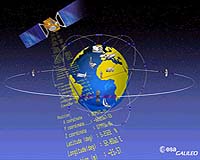
Brussels (AFP) Nov 27, 2007 EU nations are poised to break months of deadlock over their Galileo satellite navigation programme on Thursday, although they still face the sticky question of carving up the project's coveted contracts. Budget ministers and EU lawmakers paved the way for an agreement on Galileo's future on Friday by striking a deal on how to fund the project, removing a major obstacle. They agreed to fill a 2.4-billion-euro (3.6-billion-dollar) hole in Galileo's financing entirely with money from the EU's 2007 and 2008 budgets. Of that figure, two-thirds will come from unspent farm aid budgeted this year and the rest will be drawn from funds earmarked for research next year. After months of bitter wrangling between member states, a senior official with the European Union's Portuguese presidency said "a big step forward had been made" with the funding agreement. Work on Galileo, supposed to be a showcase for Europe's technical prowess, stalled earlier this year as cost over-runs piled up, the private contractors bickered and member states lobbied for their own industrial interests. As the original public-private partnership involving a consortium of eight European companies fell apart, the European Commission recommended that the project should be relaunched using public money entirely. In a sector as specialised and concentrated as the space industry, the same companies will be in the running for new contracts, although some smaller newcomers are also likely seek a share of the work. The European Commission has divided the work into six segments consisting of the satellites, launchers, computer programmes, ground stations, control stations and the system's operation. Companies will not be able to have more than two of the contracts and 40 percent of the work will have to be sub-contracted out to ensure that smaller companies also get to participate in the project. Efforts to revive the Galileo project have stalled for months amid German demands for a "fair return" on investments granted to sites in Germany, which wanted the programme to be financed only by countries whose companies participated. Although Germany was the only country to vote against Friday's agreement, paradoxically Berlin said afterwards it was satisfied with guarantees from the Commission on the participation of German companies. In the current state of things, Germany will still play the lead role through Astrium, a unit of European aerospace group EADS, in the construction of the 26 satellites that are due to follow an initial four already planned in an initial phase. Germany will also get one of the two control stations, with the other going to Italy. However, one diplomat said that some countries wanted the satellite construction to be divided among two groups to ensure that other companies also get to participate. Spain, which abstained from voting on Friday's agreement, is also demanding a control centre for such services as signals for ship safety and it remains to be seen if that will sow discord in Thursday's talks. Community Email This Article Comment On This Article Related Links GPS Applications, Technology and Suppliers
 EU antitrust regulators to probe GPS devices deal
 Brussels (AFP) Nov 28, 2007
EU regulators on Wednesday opened a detailed probe of Dutch technology group TomTom's takeover of Dutch firm Tele Atlas on concerns the deal could stifle competition in the market for hand-held navigation devices. |
|
|

| The content herein, unless otherwise known to be public domain, are Copyright 1995-2007 - SpaceDaily.AFP and UPI Wire Stories are copyright Agence France-Presse and United Press International. ESA Portal Reports are copyright European Space Agency. All NASA sourced material is public domain. Additional copyrights may apply in whole or part to other bona fide parties. Advertising does not imply endorsement,agreement or approval of any opinions, statements or information provided by SpaceDaily on any Web page published or hosted by SpaceDaily. Privacy Statement |