|
 |
 |
 |
 |
 |
 |
 |
 |

 |
ETC Finishes Final Assembly of GYROLAB GL-4000 Human Centrifuge
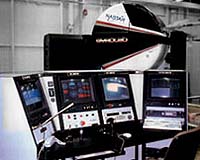
Southampton, PA (SPX) Nov 29, 2006 Environmental Tectonics is finishing final assembly of its GYROLABTM GL-4000 Advanced Spatial Disorientation Trainer for delivery to a Japanese customer before Christmas. The GL-4000 is designed to train pilots to cope with in-flight Spatial Disorientation (SD). The system features an advanced medical monitoring and data acquisition system to support full clinical and operational research into SD, loss of situational awareness and motion sickness for aircrews, space crews and space travelers. The GL-4000 is the second GYROLAB trainer to be delivered to Japan; the first, a GYROLAB GL-2000 has trained aircrew for over 15 years and remains in service today. The GL-4000 creates a simulated flight environment by employing a 4-degree-of-freedom (4DoF) motion system that provides 360 motion in pitch, roll and yaw plus centrifugal acceleration to replicate the motion and G cues that the pilot experiences in flight. The device is capable of generating up to 6 Gs in each of the degrees of freedom, to authentically replicate the flight profile of aircraft such as an F-15. The real world visuals are displayed on a high-resolution 120o by 70o projected dome display to maximize training realism and skills transfer from the GL-4000 to the aircraft. A full-feature operator console and Interactive Profile Editor gives the customer the ability to modify and customize the training profiles provided to match current needs or to create new training profiles to meet emerging training needs. "We have put significant state-of-the-art technology into this device," said William F. Mitchell, President and Chairman of ETC, "including advanced visuals and motion control. We are proud that ETC is once again setting the standard for the flight simulation industry, and we are proud to be a repeat supplier for Japan." Community Email This Article Comment On This Article Related Links Environmental Tectonics Space Tourism, Space Transport and Space Exploration News
 Russian Space Corps Has Few Applicants Due To Low Pay
 Moscow, Russia (SPX) Nov 27, 2006
According to newspaper reports, the Russian Cosmonaut Corps is facing difficulties in attracting applicants willing to work for years on wages of less than 1000 dollars a month. According to The Times of London, a team from Energia visited several universities in Moscow to encourage applications this year. but only five out of 20 students that expressed some interest took the initial medical tests, and none were deemed fit enough to proceed further. |
|
|

| The content herein, unless otherwise known to be public domain, are Copyright 1995-2006 - SpaceDaily.AFP and UPI Wire Stories are copyright Agence France-Presse and United Press International. ESA PortalReports are copyright European Space Agency. All NASA sourced material is public domain. Additionalcopyrights may apply in whole or part to other bona fide parties. Advertising does not imply endorsement,agreement or approval of any opinions, statements or information provided by SpaceDaily on any Web page published or hosted by SpaceDaily. Privacy Statement |