|
 |
 |
 |
 |
 |
 |
 |
 |

 |
ESO Detects Most Distant Hydrogen Cloud
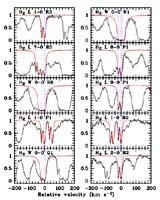
Garching, Germany (SPX) May 10, 2006 Astronomers have detected the presence of molecular hydrogen at the farthest distance ever using a quasar located 12.3 billion light-years away as a beacon. The team found the hydrogen cloud in an otherwise invisible galaxy observed when the universe was less than 1.5 billion years old - only about 10 percent of its present age. The cloud contains about one hydrogen molecule for every 250 hydrogen atoms. Similar observations for two other quasars, together with precise laboratory measurements, have allowed the scientists to infer that the ratio of the proton to electron masses may have changed with time - a finding that, if confirmed, would have important consequences for physics. "Detecting molecular hydrogen and measuring its properties in the most remote parts of the universe is important to understand the gas environment and determine the rate of star formation in the early Universe", said lead researcher C�dric Ledoux. Although molecular hydrogen is the most abundant molecule in the universe, it is difficult to detect directly. At present, the only way astronomers can detect it in the far universe is to search for its telltale signatures in the spectra of quasars or gamma-ray burst afterglows. This requires high spectral resolution and large telescopes to reach the necessary precision. The team, including astronomers with the European Southern Observatory, France and India, is conducting a survey for molecular hydrogen at high redshift using the Ultraviolent and Visible Echelle Spectrograph at ESO's Very Large Telescope array in Chile. So far, out of 75 galaxies observed, 14 exhibit molecular hydrogen. Among these, one is found having a redshift of 4.224. The astronomers detected the galaxy by using quasar PSS J 1443+2724 - some 12.3 billion light-years distant - as a beacon to illuminate the gas. The galaxy contained many spectral lines from molecular hydrogen, making it the farthest known object in the universe. The data also imply that the gas in the galaxy must be quite cold, from -90 degrees to -180 degrees Celsius (-130 degrees to -292 degrees Fahrenheit). In addition, the team found several spectral lines from metals, allowing them to deduce the amount of various chemical elements. "From the abundance of Nitrogen observed, we argue that it had to be produced in the late stage of the life of 4 to 8 solar mass stars," said team member Patrick Petitjean. "Thus, star-formation activity must have formed at least 200 to 500 million years before we are observing the galaxy, that is, when the universe was about 1 billion years old." If the galaxy once went through a phase of intense star-formation activity, at the time of the observations it appears to be in a quiescent state. "These observations demonstrate the possibility to perform these studies at the highest redshift with ESO's VLT", said team member Raghunathan Srianand. "In particular, the possibility to observe the interstellar medium of distant galaxies revealed by using gamma-ray bursts as beacons will boost this field in the near future." The astronomers made a similar set of accurate measurements of molecular hydrogen lines with UVES on the VLT toward two others quasars, Q 0405-443 and Q 0347-383. This set of data allowed them to compare the ratio of the mass of a proton to that of an electron in molecular hydrogen as it is now and how it was about 12 billion years ago. Toward this goal, they performed extremely accurate measurements of spectral lines of hydrogen molecules in the laboratory and compared the results with the same lines observed in the spectra of these quasars. The measurements show the mass ratio of the proton and the electron may have changed, becoming 0.002 percent smaller in the past twelve billion years. Such a change may seem tiny, but it would have important consequences on the understanding of physics. The team stressed, however, that their result is just an indication, and not yet a proof, so it should be confirmed by further measurements, both astronomical and in the laboratory. Community Email This Article Comment On This Article Related Links ESO Stellar Chemistry, The Universe And All Within It
 Astronomers Find Two New Milky Way Companions
 Cambridge, United Kingdom (SPX) May 10, 2006
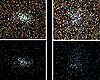
British astronomers said Monday they have discovered two new, very faint companion galaxies to the Milky Way. The first was found in the direction of the constellation Canes Venatici, or the Hunting Dogs, by Daniel Zucker of Cambridge University. |
|
|

| The content herein, unless otherwise known to be public domain, are Copyright 1995-2006 - SpaceDaily.AFP and UPI Wire Stories are copyright Agence France-Presse and United Press International. ESA PortalReports are copyright European Space Agency. All NASA sourced material is public domain. Additionalcopyrights may apply in whole or part to other bona fide parties. Advertising does not imply endorsement,agreement or approval of any opinions, statements or information provided by SpaceDaily on any Web page published or hosted by SpaceDaily. Privacy Statement |