|
 |
 |
 |
 |
 |
 |
 |
 |

 |
ESA's Microgravity Science Glovebox On Station
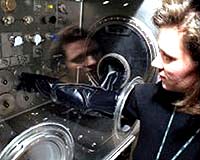
Paris - June 10, 2002 ESA's Microgravity Science Glovebox (MSG) was delivered to the Internation Space Station as part of the logistics module, MPLM-Leonardo that Endeavour transported to the station. Commenting on the occasion of the MSG launch, ESA's Director of Human Spaceflight and Microgravity, Mr. Feustel-B�echl said: "MSG is the first European provided research facility to have been launched to the ISS; the first to have completed the verification programme for this class of payloads, becoming the reference for the future development of ISS payloads .It is an example of positive, close cooperation and coordination between ESA and NASA as well as with European Industry." The MSG will enable astronauts on board the ISS to perform a wide variety of materials, combustion, fluids and biotechnology experiments as well as investigations in the microgravity environment. It can also accommodate minor repairs and servicing of hardware requiring a controlled working environment. The facility offers users a wide range of innovative, utilization alternatives from manual control by astronauts via laptop computers to fully automated and remote control from Earth ("Telescience"). A permanent data exchange link with ground stations is also ensured. The MSG will be integrated and used in the US Destiny Laboratory for a projected operational period of ten years. ESA is planning to use the facility for European experiments.The first time MSG will be used by a European astronaut to perform European experiments will be during a Soyuz "taxi flight" mission in October 2002. ESA's Belgian astronaut Frank De Winne will perform four different experiments in the MSG in the field of protein crystallization, zeolites crystallization, combustion and fluid science. The prime contractor for the development of the MSG is Astrium GmbH (D) with Bradford Engineering (NL), Verhaert Design and Development (B), ATOS-ORIGIN (NL) and Laben (I) as subcontractors. Community Email This Article Comment On This Article Related Links SpaceDaily Search SpaceDaily Subscribe To SpaceDaily Express Space Technology News - Applications and Research
 NGC Chosen To Proceed With Developing Solid-State Laser Technology For Military Applications
 Redondo Beach CA (SPX) Jan 09, 2006
Northrop Grumman Corporation has been selected to develop "military-grade," solid-state laser technology that is expected to pave the way for the U.S. military to incorporate high-energy laser systems across all services, including ships, manned and unmanned aircraft, and ground vehicles. |
|
|

| The content herein, unless otherwise known to be public domain, are Copyright 1995-2006 - SpaceDaily.AFP and UPI Wire Stories are copyright Agence France-Presse and United Press International. ESA PortalReports are copyright European Space Agency. All NASA sourced material is public domain. Additionalcopyrights may apply in whole or part to other bona fide parties. Advertising does not imply endorsement,agreement or approval of any opinions, statements or information provided by SpaceDaily on any Web page published or hosted by SpaceDaily. Privacy Statement |