|
 |
 |
 |
 |
 |
 |
 |
 |

 |
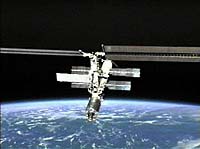
ESA To Help China Join ISS
Beijing - July 29, 2001 China may gain access to the International Space Station (ISS) with the help of the European Space Agency (ESA), the Hong Kong-based pro-Beijing newspaper Wen Wei Po reports today (July 28). The newspaper discloses that ESA and the Chinese space agency China National Space Administration (CNSA) have reached "an intention to collaborate" towards admitting China to the ISS project in the near future. According to unnamed sources, ESA will discuss and set the timeline during its ministerial level Council meeting in November in Edinburgh, U.K. The news comes only five days after the newspaper reports that the next unmanned test flight of the Shenzhou manned spacecraft, the Shenzhou-3 mission, would likely take place shortly. As a founding member of the multinational project, ESA's assistance would give China a huge boost to participate in the international space project. On Dec. 27 last year Chinese Minister of Science and Technology Zhu Lilan announced an initiative which would expand China's international scientific cooperation. Among the goals in the initiative is joining the ISS project. Zhu said that the government would increase funding by at least $100 million renminbi ($12.1 million US) beginning this year, the first year of the current and 10th Five-Year Economic Plan, for international scientific cooperation projects. Zhu added that participation in international science projects would benefit the nation and improve its international competitiveness. Collaboration between China and ESA in space exploration is at an unprecedented level. Three weeks ago CNSA and ESA signed a historic agreement which confirmed the European contribution in scientific payload to the Chinese Double Star mission, a twin spacecraft mission that would study the magnetosphere of the Earth. An admittance to the ISS project would give China invaluable experience in manned spaceflight technologies and operation, including the management of a manned space platform. Chinese space specialists in Beijing told Wen Wei Po that generally an objective of a manned space program would be to establish space testing facilities and a space station. These specialists reckon that China could achieve technological breakthroughs to build its space station in the new century. The specialists pointed out that the most difficult problem to solve when building a space station would be its life expectancy, and how to extend it through maintenance. "According to the current technology, at least five years of life expectancy [of the space station] can be guaranteed. The Shenzhou spacecraft is only a transportation system that shuttles between space and earth; it is a tool in the manned space project," said a specialist. "In terms of solving the life expectancy problem, China has a definite fundamental technology. For example the life expectancy of Dongfanghong-2 (DFH-2, Dongfanghong means "East Is Red") communications satellite is five to six years, and the designed life of DFH-3 communications satellite, which has been in operation for three years, is eight years." Other essential problems that the specialists identify include: * Long-term maintenance of the on-board living and working conditions. * Yuhangyuans ("astronauts") performing extravehicular activities (EVAs), or spacewalks, which would require reliable spacesuits, for troubleshooting and maintenance. * Rendezvous and docking. If these problems were not resolved, the specialists said that the qualification to build a permanent space station would be lacking. These specialists believe that the key to whether China would successfully build its own space station rests on how much the nation invests in the program. A specialist comments: "All previous Chinese space experiments were one-time applications, maintenance was unnecessary. Technologically speaking a space station has a higher degree of difficulty. Besides, yuhangyuans would shuttle back and forth and the cost would be enormous." "Why did Russia abandon the Mir space station? An important reason was lack of funding," the specialist added. The very same issue of funding shortfall may be a reason why the Chinese manned space project is progressing at a slower pace than the equivalent stage of the manned programs of the former Soviet Union and the United States. While many technical issues are involved in a space station construction and operation, China has demonstrated a basic capability in maintaining the altitude of an orbiting platform that could be used in manned operations for an extended period. In the last unmanned test of the Shenzhou spacecraft, after the SZ-2 Descent Module returned to Earth, mission controllers kept the Orbital Module in space for more than half a year and maintained its altitude through several orbit-raising maneuvers. Chinese scientists also announced three weeks ago that on-board experiments, namely the astrophysics and space environment experiments, returned useful data throughout the extended mission and led to major breakthroughs both in science findings and technological capabilities. After 233 days in space, the SZ-2 Orbital Module is in an orbit of 290.3 x 311.1 km inclined at 42.6 deg and a period of 90.5 minutes. Compared to its average orbit a fortnight ago, the present orbit is almost 20 km lower. The Orbital Information Group (OIG) at NASA Goddard Space Flight Center forecasts in its latest 60-Day Decay Forecast Report, dated July 20, that the SZ-2 Orbital Module would decay on Aug. 14. Thus it appears that mission controllers no longer maintain the altitude of the Orbital Module and the extended mission is coming to an end. However, it is not known whether the on-board experiments are still transmitting data. Meanwhile China is gearing up launch preparation of the unmanned SZ-3 mission. The mission will see similar suite of science experiments and another extended operation of the Orbital Module. Community Email This Article Comment On This Article Related Links SpaceDaily Search SpaceDaily Subscribe To SpaceDaily Express Space Station News at Space-Travel.Com
 NASA Had No Choice But To Buy Soyuz Flights
 Washington DC (SPX) Jan 09, 2006
NASA's announcement last week that it will pay Roskosmos $43.6 million for a round-trip ride to the International Space Station this spring, and an equivalent figure for an as-yet-undetermined number of future flights to the station until 2012, represents the agency's acknowledgment that it had no alternative. |
|
|

|
|
|
|
|
|
|
|
|
|
|
|
| The content herein, unless otherwise known to be public domain, are Copyright 1995-2006 - SpaceDaily.AFP and UPI Wire Stories are copyright Agence France-Presse and United Press International. ESA PortalReports are copyright European Space Agency. All NASA sourced material is public domain. Additionalcopyrights may apply in whole or part to other bona fide parties. Advertising does not imply endorsement,agreement or approval of any opinions, statements or information provided by SpaceDaily on any Web page published or hosted by SpaceDaily. Privacy Statement |