|
 |
 |
 |
 |
 |
 |
 |
 |

 |
ESA Selects Targets For Asteroid-Deflecting Mission Don Quijote
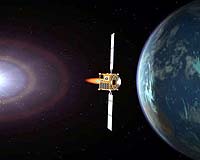
Paris (ESA) Sep 27, 2005 Based on the recommendations of asteroid experts, ESA has selected two target asteroids for its Near-Earth Object deflecting mission, Don Quijote. Don Quijote is an asteroid-deflecting mission currently under study by ESA's Advanced Concepts Team (ACT). Earlier this year the NEO Mission Advisory Panel (NEOMAP), consisting of well-known experts in the field, delivered to ESA a target selection report for Europe's future asteroid mitigation missions, identifying the relevant criteria for selecting a target and picking up two objects that meet most of those criteria. The asteroids' temporary designations are 2002 AT4 and 1989 ML. With this input and the support of ESA's Concurrent Design Facility (CDF) experts, the Advanced Concepts Team has now completed an extensive assessment of suitable mission architectures, launch strategies, propulsion system options and experiments. The current scenario envisages two spacecraft in separate interplanetary trajectories. One spacecraft (Hidalgo) will impact an asteroid, the other (Sancho) will arrive earlier at the target asteroid, rendezvous and orbit the asteroid for several months, observing it before and after the impact to detect any changes in its orbit. Industrial studies are now about to start; it will be down to European experts to propose alternative solutions for the design of the low-cost NEO precursor mission. This will be the first step towards the development of a means to tackle asteroid impacts � one of the few natural disasters that our technology can prevent.
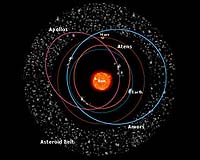
A near miss? While the eyes of the world were on the Asian tsunami last Christmas, one group of scientists were watching uneasily for another potential natural disaster � the threat of an asteroid impact. On 19 December 2004 MN4, an asteroid of about 400 m, lost since its discovery six months earlier, was observed again and its orbit was computed. It immediately became clear that the chances that it could hit the Earth during a close encounter in 2029 were unusually high. As the days passed the probability did not decrease and the asteroid became notorious for surpassing all previous records in the Torino and Palermo impact risk scales - scales that measure the risk of an asteroid impact just as the Richter scale quantifies the size of an earthquake. Only after earlier observations of the object were found and a more accurate trajectory was computed did it become clear that it would not impact the Earth � at least not in 2029. Impacts on later dates, though unlikely, have not been totally ruled out. It is extremely difficult to tell what will happen unless we come up with a better way to track this or other NEOs and if necessary take steps to tackle them. Most world experts agree that this capability is now within our reach. A mission like ESA's Don Quijote could provide a means to assess a threatening NEO and take concrete steps to deflect it away from the Earth. But every good performance needs rehearsing and in order to be ready for such a threat, we should try our hardware on a harmless asteroid first. Don Quijote would be the first mission to make such an attempt. The big question was: which asteroid and what should it be like?
Looking for the perfect target The NEO population contains a confusing variety of objects, and deciding which physical parameters are most relevant for mitigation considerations is no trivial task. But the NEOMAP experts took on the challenge and in February 2005 provided ESA with their recommendations on the asteroid selection criteria for ESA's deflection rehearsal. People might wonder whether performing a deflection test, such as that planned for Don Quijote, represents any risk to our planet. What if things go wrong? Could we create a problem, rather than learn how to avoid one? Experts world-wide say the answer is no. Even a very dramatic impact of a heavy spacecraft on a small asteroid would only result in a minuscule modification of the object's orbit. In fact the change would be so small that the Don Quijote mission requires two spacecraft � one to monitor the impact of the other. The second spacecraft measures the subtle variation of the object's orbital parameters that would not be noticeable from Earth.

|