|
 |
 |
 |
 |
 |
 |
 |
 |

 |
ESA Reassures Its Taxpayers: Mars Won't Be Done Cheap
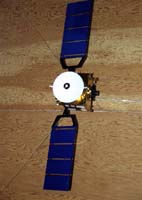
Paris (AFP) December 13, 1999 - The ESA sought to reassure its European taxpayers last week that it would not sacrifice reliability for cost savings following the disastrous failure of two US cut-price missions to Mars. The 14-nation consortium issued a press statement insisting that its own Mars shot, due to be launched in June 2003, would "forge ahead" taking into account any lessons from the US setback, but with engineering quality and achievable goals firmly in mind. It did not openly criticise the "faster, cheaper, better" philosophy behind the US campaign and expressed great sympathy for NASA colleagues who had seen their dreams fail. The 125-million-dollar Mars Climate Orbiter and the 165-million-dollar Mars Polar Lander disappeared within just over 10 weeks of each other, on September 23 and December 3, as they were sent down to the red planet. Some analysts have suggested the failures may have been caused by haste and budget constraints that may have left equipment untested or bugs in computer programmes. ESA said its future Mars Express mission was also being built more quickly and cheaply than any of the agency's previous comparable planetary missions. "If one does a mission cheap and fast, then risk goes up," Mars Express project manager Rudi Schmidt said. "But we are taking steps to reduce it by choosing the simplest possible design, performing a lot of system level testing, using existing designs and hardware, maintaining a conventional quality assurance programme and reducing flexibility and services to the scientific payload." Mars Express will be "taking on board" all the lessons that could be learnt from the Polar Lander failure, he said. NASA initiated its "smaller, faster, cheaper" approach after the loss of an 800-million-dollar probe, Mars Observer, in 1993. The premise is that modern technology can enable scientists to build and launch several smaller probes quickly for the price of a big one. The loss of one of the probes would not in itself be a big setback. The 150-million-dollar Mars Express programme aims to send a lander to the red planet as part of an international exploration effort in the first decade of the next century.
Email This Article Comment On This Article Related Links Space
 Satellite Launch To Boost DTH In India
 Calcutta, India (SPX) Dec 28, 2005
The successful launch Thursday of India's heaviest satellite from spaceport of Kourou in French Guyana may have boosted the country's space research efforts to yet another level, but it has also lifted the spirits of at least three Direct-To-Home televisions broadcasters, one of which has been waiting for years to launch its services in India. |
|
|

|
|
|
|
|
|
|
|
|
|
|
|
| The content herein, unless otherwise known to be public domain, are Copyright 1995-2006 - SpaceDaily.AFP and UPI Wire Stories are copyright Agence France-Presse and United Press International. ESA PortalReports are copyright European Space Agency. All NASA sourced material is public domain. Additionalcopyrights may apply in whole or part to other bona fide parties. Advertising does not imply endorsement,agreement or approval of any opinions, statements or information provided by SpaceDaily on any Web page published or hosted by SpaceDaily. Privacy Statement |