|
 |
 |
 |
 |
 |
 |
 |
 |

 |
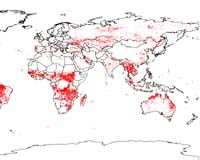
ESA Makes World Fire Maps Available Online
Paris, France (SPX) May 25, 2006 ESA announced Wednesday it is making its satellite-compiled worldwide fire maps available to users online in near-real time through ESA's ATSR World Fire Atlas. The data � the first multi-year global fire atlas ever developed � will be available approximately six hours after acquisition and represents an important scientific resource because fire is a major agent of environmental change. "The atlas is an excellent resource that provides a glimpse of the world that was not previously possible, and which is certain to allow ecologists to address both new and old questions regarding the role of fire in structuring the natural world," said Matt Fitzpatrick of the University of Tennessee's Department of Ecology & Evolutionary Biology. More than 50 million hectares of forest burn annually, and these fires have a significant impact on global atmospheric pollution, with biomass burning contributing to the global budgets of greenhouse gases such as carbon dioxide. In the past decade, researchers have realized the importance of monitoring this cycle, ESA said in a statement. WFA data currently are being accessed mostly for atmospheric studies. Quantifying fire is important for the ongoing study of climate change. The 1998 El Ni�o, for example, helped encourage fires across Borneo which emitted up to 2.5 billion ton of carbon into the atmosphere, equivalent to Europe's entire carbon emissions that year. More than 200 registered users currently access the WFA in Europe, Asia, North America, South America, Africa and Australia for research in atmospheric chemistry, land use change, global change ecology, fire prevention and management and meteorology. Harvard University, the University of Toronto, the National Center for Atmosphere and NASA, among others, have used the data in research publications. To date, more than 100 scientific publications are based on WFA data. In addition to maps, the time, date, longitude and latitude of the hot spots are provided. The database covers 1995 to present, but complete yearly coverage begins from 1997. The WFA data are based on results from the Along Track Scanning Radiometer on ESA's ERS-2 satellite, launched in 1995, and the Advanced Along Track Scanning Radiometer on ESA's Envisat satellite, launched in 2002. The twin radiometer sensors work like thermometers in the sky, measuring thermal infrared radiation to take the temperature of Earth's land surfaces. Fires are detected best during local night, when the surrounding land is cooler. Temperatures exceeding 312 degrees Kelvin (38.85 degrees Celsius or 101 degrees Fahrenheit) are classified as burning fires by ATSR/AATSR, which are capable of detecting fires as small as gas flares from industrial sites because of their high temperature. Community Email This Article Comment On This Article Related Links World Fire Atlas ESA Earth Observation News - Suppiliers, Technology and Application
 Province Of Ontario Secures Quickbird Imagery Library
 Longmont CO (SPX) May 22, 2006
DigitalGlobe's Canadian business partner, MDA's Geospatial Services, has entered into a contract to provide over 120,000 square kilometers of QuickBird satellite imagery to the Ontario Ministry of Natural Resources. |
|
|

| The content herein, unless otherwise known to be public domain, are Copyright 1995-2006 - SpaceDaily.AFP and UPI Wire Stories are copyright Agence France-Presse and United Press International. ESA PortalReports are copyright European Space Agency. All NASA sourced material is public domain. Additionalcopyrights may apply in whole or part to other bona fide parties. Advertising does not imply endorsement,agreement or approval of any opinions, statements or information provided by SpaceDaily on any Web page published or hosted by SpaceDaily. Privacy Statement |