|
 |
 |
 |
 |
 |
 |
 |
 |

 |
ESA Director Jose Achache Unveils New Observing The Earth Website
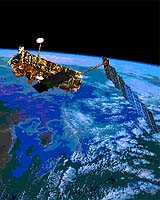
Paris (ESA) Jul 20, 2004 What is the use of Earth Observation? Quite a lot is the short reply; the full list gets longer all the time. For the complete answer, visit ESA's new Observing the Earth Portal, redesigned to highlight the growing number of applications of this unique technique, and featuring a mass of information on the full scope of ESA remote sensing activities. To mark its launch, ESA Earth Observation Director Jose Achache explains the thinking the new Portal has been designed around, and shares his views on the past, present and future of Earth Observation.
How has the concept of Earth Observation developed over the years? "Since then, a remarkable change in perspective has taken place. The process of space exploration served to underline the unique value and fragility of the Earth environment. And today, space has come back to Earth in a very practical way: the data returned from satellites turns out to have qualities that classical ground-based observation techniques simply cannot match. "Measurements from space are global, continuous, objective and precise. This rich source of information gives us the ability to perceive our planet in many new and varied ways, and this is an ability that can be put to a wide variety of potential uses. "Maximising its take-up has been a priority of the Earth Observation Directorate in recent years, with a strategy of fostering the development of new applications and services based on user needs."
Does this strategy involve reaching out beyond purely scientific users? "The Portal has been designed to inform people in a clear way not just about individual missions but about Earth Observation as a whole: how it is a tool to improve scientific understanding of our planet, but at the same time helping to secure our environment, and also increasingly enabling value-added services to benefit our economy. "In fact, the Portal is directly based around this set of themes: space to understand, to secure and to benefit. Each of these themes features within them a number of introductory background articles and highlighted examples, as well as links to related ESA resources."
How does Earth Observation help to better understand our planet? "Accurately characterising these various interrelated components of the Earth system improves our knowledge of its current state, but also our potential to predict its future evolution." "There was a time when the Earth sciences were concentrated on the past, modelling how various geomorphic phenomena gave rise to the world, its landscapes and climate. Now the field is coming to be attached to the future tense, as it responds to new needs concerning the forecasting of climate change, the evolution of the global environment and the incidence of natural disasters. "Nowadays the knowledge of the laws of physics enables increasingly sophisticated numerical models of the Earth system that allow scientists to extrapolate its future state. The more closely these models match observed reality the more confident we can be in their predictions. By assimilating data from satellites these models are being established as reliable forecasting tools."
What role can satellites play in securing our environment? "The most high-profile example is ESA's joint endeavour with the European Union called Global Monitoring for Environment and Security (GMES). The aim of GMES is to set up information-gathering infrastructures and services for governments, administrations and municipal authorities." "Its remit includes the forecasting and managements of natural risks, management of resources, monitoring and implementing major international environmental agreements, the management of wetlands and rural areas, and the conservation of biodiversity and national heritage." "ESA has commenced with the five-year GMES Services Element (GSE) comprising operational services integrating space and ground-based observations. Many of these services have evolved from existing pilot projects � also detailed in the new Portal - dealing with activities such as international treaty implementation and supporting civil protection agencies." "To give one current example of how Earth Observation is helping to secure people and the environment, ESA has been a founding member of the international Charter on Space and Major Disasters, committing world space agencies to supply satellite data to civil protection groups responding to natural or man-made disasters. In less than four years the Charter has been activated more than 50 times."
And how does Earth Observation benefit our economy? "Beyond this now self-sustaining aspect of Earth Observation, we have been working hard to develop other applications for commercial activities. There has been a long history of attempting to commercialise Earth Observation during the last 20 years, but with an early emphasis on direct selling of satellite imagery rather than value-adding services." "The example of weather forecasting shows how this initial strategy was flawed � the ordinary person watching the weather on television is not interested in the satellite image alone but the analysis and forecast derived from that image." "Our emphasis now is on tailoring Earth Observation-based information products and services for specialised market segments, and doing this by fostering links between the Earth Observation industry and new user groups." "The result has been the start of specific services serving such activities as oil and gas exploration, forest management, agricultural � most notably rice - forecasting, and ship navigation through sea ice and bad weather." "More broadly, Earth Observation can also underpin our future economic development by ensuring it occurs in a sustainable way, with natural resources being exploited at a replaceable rate." "The 2002 World Summit on Sustainable Development in Johannesburg made clear the role space-based systems could play in helping to manage growth so that finite resources such as agricultural land and clean water are not diminished." "Detailed information on all this work is available at the new Earth Observation Portal. I hope people will visit it so they can judge the importance of these activities for themselves."
Director Achache, thank you very much. Email This Article Comment On This Article Related Links Earth Observation at ESA SpaceDaily Search SpaceDaily Subscribe To SpaceDaily Express Earth Observation News - Suppiliers, Technology and Application
 New Legislation Initiated To Support Commercial Remote Sensing Industry
 New York NY (SPX) Jan 11, 2006
The importance of remotely sensed data and technologies to support natural disasters has prompted attention and action in Washington. New initiatives and legislation authorizing appropriations to the remote sensing industry will be discussed at Strategic Research Institute's U.S. Commercial Remote Sensing Industry conference, scheduled for February 9-10, 2006 in Washington D.C. |
|
|

| The content herein, unless otherwise known to be public domain, are Copyright 1995-2006 - SpaceDaily.AFP and UPI Wire Stories are copyright Agence France-Presse and United Press International. ESA PortalReports are copyright European Space Agency. All NASA sourced material is public domain. Additionalcopyrights may apply in whole or part to other bona fide parties. Advertising does not imply endorsement,agreement or approval of any opinions, statements or information provided by SpaceDaily on any Web page published or hosted by SpaceDaily. Privacy Statement |