|
 |
 |
 |
 |
 |
 |
 |
 |

 |
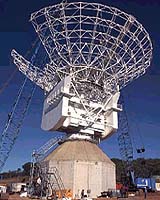
ESA Deep Space Ground Station Successfully Tracks Spacecraft
New Norcia - Jun 20, 2002 A major milestone towards operational readiness of ESA's first 35m deep space ground station at New Norcia (W. Australia) was achieved. As part of the final system testing, antenna pointing tests were carried out with the STARDUST spacecraft on June 07 and June 11, 2002. The 630 tons antenna dish successfully acquired the signal from the spacecraft currently 2.1 AU away from the Earth. The New Norcia station will provide prime support to ESA's Rosetta and Mars Express scientific missions as of 2003. Stardust, controlled by NASA/JPL, was chosen as a candidate for tracking tests with ESA's new 35m deep space ground station at New Norcia (W. Australia), because it is on an interplanetary trajectory (currently 2.1 AU from the Earth), transmits a downlink signal in X-band, and reaches a high maximum elevation of over 70 deg as seen from New Norcia. For spacecraft power reasons, routine NASA/DSN tracking passes from Canberra are limited in duration to two hours. During the pass in the evening (UTC) of 7th June (early morning local time on 8th June) the New Norcia ground station was driven to follow the spacecraft and received the spacecraft signal. This test was possible due to the cooperation of the Stardust Project Manager, Tom Duxbury, and his team at JPL who willingly supplied the characteristics of the signal and provided precise orbital data for Stardust. The first track test was on Friday 7/6/2002, starting at 20:41 UTC, duration two hours. The main objective from this first attempt was to see the downlink signal on a spectrum analyser, and confirm the quality of the pointing of ESA's new antenna. The ESOC acquisition team on site (Gerard Galtie, Peter Droll, Marco Lanucara, and Sandro Salvatori) prepared a spectrum analyser at the output of the antenna downlink chain, configured for catching the low signal coming from the spacecraft. Indeed the power of the downlink signal in deep space missions is generally slightly above the noise power, that requires the received frequency to be known in advance at a certain time or, if this is not achievable, some tricky action to be performed to localise the signal. Using the preliminary information kindly provided by JPL to our Flight Dynamics and then on-passed to New Norcia, plus some signal search activity, it was possible to localise the spacecraft spectrum approximately half an hour after the nominal downlink switch-on. Most of the remaining tracking time (1.5 hours) was used to check the accuracy of the pointing, which confirmed good results. The second track was on Tuesday 11/6/2002. The nominal start was supposed to be at 18:00 UTC, but the signal was acquired 6 minutes before, around the expected frequency position. The objective during this track was to confirm the pointing with additional tests, and to confirm the capability of the Intermediate Frequency Modem System (IFMS) to precisely track the downlink carrier for orbit determination purposes. Both objectives were achieved, the pointing was quite accurate and the IFMS was able to track the downlink carrier for the entire pass. Community Email This Article Comment On This Article Related Links ESA SpaceDaily Search SpaceDaily Subscribe To SpaceDaily Express Space Technology News - Applications and Research
 Industry Team Achieve New Communications Technology With AESA Radars
 Baltimore MD (SPX) Jan 12, 2006
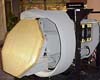
A team comprised of three leading US aerospace and defense contractors has demonstrated an innovative technological use of active electronically scanned array (AESA) radars for high-bandwidth communications. |
|
|

| The content herein, unless otherwise known to be public domain, are Copyright 1995-2006 - SpaceDaily.AFP and UPI Wire Stories are copyright Agence France-Presse and United Press International. ESA PortalReports are copyright European Space Agency. All NASA sourced material is public domain. Additionalcopyrights may apply in whole or part to other bona fide parties. Advertising does not imply endorsement,agreement or approval of any opinions, statements or information provided by SpaceDaily on any Web page published or hosted by SpaceDaily. Privacy Statement |