|
 |
 |
 |
 |
 |
 |
 |
 |

 |
ESA Camera Catches Comet Break-up In The Act
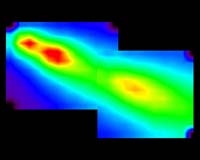
Tenerife, Canary Islands (SPX) May 21, 2006 ESA scientists are using a new camera to monitor the continuing disintegration of 73P/Schwassmann-Wachmann 3, in an effort to attempt to see into the comet's interior. The Superconducting Camera, or SCAM - now operating from ESA's Optical Ground Station on Tenerife - is an ultra-fast photon-counting instrument cooled to just 300 thousandths of a degree above absolute zero. This enables its sensitive superconducting tunnel detectors to register almost every single photon of light that falls onto them. Comet 73P/Schwassmann-Wachmann 3 is a short-period body that approaches the Sun every 5.4 years. Two appearances ago, in 1996, astronomers saw the comet nucleus had split into five pieces (Fragments A, B, C, D, E), three of which (B, C, E) were still visible at its 2001 return. When it appeared again this year, astronomers initially saw seven fragments, with more breaking off as the comet approached the Sun. Fragment B alone produced at least seven new pieces. At present, about 40 fragments are visible, most of which are likely to be very small and with irregular and short-lived activity. Technicians attached SCAM to the one-meter ESA Optical Ground Station telescope on May 7. Every few microseconds, the camera reads out both the number of photons that have touched it and their color. Using the unprecedented accuracy of the camera, ESA scientists charted the evolution of the dust and gas envelopes associated with each fragment for two hours. Those data will provide the framework for new analyses. Astronomers will be looking for differences in the size and shape of the fragments and also any color differences that might indicate compositional differences. SCAM also makes possible unrivalled time resolution. Outbursts and activity from each fragment can be traced down to changes that occur on a timescale of one minute. The dust and gas particles released from the comet fragments are moving at velocities between 0.5 kilometer and 1 kilometer per second (1,100 miles to 2,200 miles per hour). Using SCAM, astronomers are able to observe the interaction of the gas and dust flow. 73P/Schwassmann-Wachmann 3 once was considered a potential target for ESA's Rosetta mission. In 1995, however, even before the comet began splitting, it was abandoned in favor of comet 46P/Wirtanen. After the launch delay of 2003, ESA decided not to re-select 73P/Schwassmann-Wachmann 3 as the replacement Rosetta target, because of the comet's volatile behavior. In 2014, Rosetta will rendezvous and land on the Jupiter-family comet 67P/Churyumov-Gerasimenko. Community Email This Article Comment On This Article Related Links SCAM Asteroid and Comet Mission News, Science and Technology
 Crumbling Comet Has NASA Scientists Looking For Crater Chains
 Washington DC (SPX) May 15, 2006
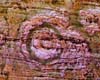
In a remote windswept area named Aorounga, in Chad, there are three craters in a row, each about 10 kilometers (6.2 miles) in diameter. "We believe this is a crater chain formed by the impact of a fragmented comet or asteroid about 400 million years ago in the Late Devonian period," said Adriana Ocampo of NASA headquarters. |
|
|

| The content herein, unless otherwise known to be public domain, are Copyright 1995-2006 - SpaceDaily.AFP and UPI Wire Stories are copyright Agence France-Presse and United Press International. ESA PortalReports are copyright European Space Agency. All NASA sourced material is public domain. Additionalcopyrights may apply in whole or part to other bona fide parties. Advertising does not imply endorsement,agreement or approval of any opinions, statements or information provided by SpaceDaily on any Web page published or hosted by SpaceDaily. Privacy Statement |