|
 |
 |
 |
 |
 |
 |
 |
 |

 |
ESA Bring Extra Dimension to Industrial Products Imaging
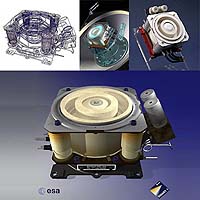
Paris, France (ESA) Nov 22, 2005 When ESA experts wanted to see what the ion engine designed for the SMART-1 mission to the Moon would finally look like, they contacted a French start-up company: News'UProduction. The new technique they came up with is now being further developed in ESA's European Space Incubator. Jean-Luc Atteleyn, photographer and CEO of News'UProduction says: "We managed to produce high quality and realistic images and animations of the engine based upon classical 3D design drawings. This was carried out in close collaboration with the design studio at SNECMA, the company responsible for producing the ion engine." This new technique combined a 3-dimensional model of the engine using traditional design software tools with photographic expertise. The result was an image of an engine still at the drawing board stage that united accuracy with texture and colour to give a very realistic impression of the engine's final appearance.
Technical design with creative flair The objective of Jean-Luc Atteleyn is to produce high-quality images and animations of industrial items while they are still in the design stage; images that in quality and appearance are comparable to photographs of the final product. To do this, Atteleyn and his partner Patrick Callet, a teacher at Ecole Centrale in Paris and a researcher in optics and physics, have defined a materials database that can be read by special visualisation software. The database stores the optical behaviour and visual appearance of materials together with other characteristics and physical properties. The visual appearance is described using the standards defined by the International Commission on Illumination (CIE), making it easier to compare different materials as the descriptions are objective and not subjective. "Our database allows the user to visualise the optical behaviour of a material in normal pre-defined conditions and to modify the visual appearance of an object by modifying the composition of the material," explains Callet. "In the future it could be possible to create new materials by mixing existing materials, each with its own known properties. New materials could be identified by criteria such as lighting, colour and iridescence, or on mechanical properties such as water and thermal resistance, hardness and durability. This 'material composer' could meet industrial needs to combine several end-product requirements with final appearance." "The pictures and animations we create using this new technique enable our customers to see their final product and to evaluate its visual appearance before starting production. The aim is to reduce the time and costs associated with the development and commercialisation of new products, thus reducing the time-to-market, a very important factor for today's industry," explains Atteleyn. Marc Van Eesbeek, head of ESA's Materials Physics and Chemistry Section, foresees more possible uses for the News'UProduction technique once it is fully matured: "Their material database is very interesting. We could, for example, define the thermal-optical properties of materials in the UV and infrared frequency band, or simulate the temperature and lifetime consequences on structures, and maybe find new potential solutions via their materials database."
Virtual photographic studio at ESI Since May 2005, News'UProduction's 'virtual photo studio' tool is being developed within the framework of ESA's Technology Transfer and Promotion Office's European Space Incubator (ESI). Together with another 34 ESI projects that have been selected for the ESI, News'UProduction is being offered support from ESA scientists and engineers to build up their technique to make a first prototype. ESI Network Manager, Bruno Naulais, says, "The next step is to transform this into a business product so that the system and their services can be sold to non-space industries." "In ESI we help start-up companies to draw up a business plan, establish partnerships and make contact with venture capitalists, as well as provide initial office space and accounting assistance. All of these are important aspects in starting a business and getting it up and running." ESI is the central hub of the European Space Incubators NETwork (ESINET) that links together nearly 40 national and regional incubators within Europe and Canada. This network provides start-up companies with transnational partnership opportunities and helps them gain increased visibility within Europe. The expertise of ESI comes from years of successful technology transfer from space to non-space sectors. Pierre Brisson, head of ESA's Technology Transfer and Promotion Office says: "Even before ESI started in 2002, ESA's Technology Transfer Programme resulted in the creation of more than 30 start-up companies in Europe, all using space technology and expertise in non-space applications. ESI has allowed us to streamline the process of helping entrepreneurs set-up new businesses." Community Email This Article Comment On This Article Related Links ESA's Technology Transfer Programme SpaceDaily Search SpaceDaily Subscribe To SpaceDaily Express Space Technology News - Applications and Research
 Industry Team Achieve New Communications Technology With AESA Radars
 Baltimore MD (SPX) Jan 12, 2006
A team comprised of three leading US aerospace and defense contractors has demonstrated an innovative technological use of active electronically scanned array (AESA) radars for high-bandwidth communications. |
|
|

| The content herein, unless otherwise known to be public domain, are Copyright 1995-2006 - SpaceDaily.AFP and UPI Wire Stories are copyright Agence France-Presse and United Press International. ESA PortalReports are copyright European Space Agency. All NASA sourced material is public domain. Additionalcopyrights may apply in whole or part to other bona fide parties. Advertising does not imply endorsement,agreement or approval of any opinions, statements or information provided by SpaceDaily on any Web page published or hosted by SpaceDaily. Privacy Statement |