|
 |
 |
 |
 |
 |
 |
 |
 |

 |
ESA Awards Mars Micro Rovers
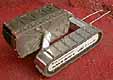
Paris - April 25, 1999 - A Belgian-led consortium has been awarded a contract by the European Space Agency (ESA) to design and develop a complete system for controlling a rover on Mars. The contract was awarded to Belgium in competition with major aerospace industries in France, Germany and Italy, and will result in a complete Mars rover control system that will be qualified for launch on an Ariane 5 rocket. As demonstrated by NASA's Pathfinder mission and the highly celebrated Sojourner rover, robotics and rovers are essential elements of missions to explore planets and comets, to deploy instruments around a lander spacecraft, to provide visual observation, to sample surface material, and to feed analysis instruments. Such robotics have to function properly and be versatile in poorly known and often difficult terrain, with very restricted means of intervention from Earth due to the extreme remoteness. The European approach to planetary rovers is to build smaller rovers, so-called "micro-rovers" or even "nano-rovers". The rover having obtained the highest rating by ESA in a recent comparison of five different designs, is the "Nanokhod" rover, which is a rugged, simple, reliable yet effective rover, to deploy instruments in the surroundings of a lander. It is equipped with a tether cable, providing the rover with power and data connection to the lander. The rover is able to carry four scientific instruments to analyse different aspects of the soil and rocks on Mars, whereas Sojourner carried only one instrument. Depending on the constellation of the planets, it takes between 10 and 40 minutes for radio signals to travel back and forth between Earth and Mars. This makes it impossible to control a Mars rover like driving a radio-controlled toy car here on Earth. Instead, high-level commands, stating the destinations the rover should go to and the preferred path, are generated on Earth and sent to the lander on the Martian surface. The lander control system on Mars afterwards controls the details of the rover's actual path to avoid obstacles in order to safely reach the destinations without tipping over or getting stuck. The prime contractor is Space Applications Services (SAS) in Zaventem, who will design the complete system for the control of the Nanokhod rover, and implement the ground control station to define and programme the high-level commands, and to visualize a simulated rover moving in real-time in a model of the terrain around the lander obtained from images transmitted from stereo-cameras on the lander. SAS is in this project supported by the Katholieke Universiteit Leuven (KUL) for terrain modelling / visualisation and path planning and by OptiDrive in Heverlee for the mechanical structure on which the stereo cameras are mounted; by the German Aerospace Centre (DLR) for lander software and space-qualified cameras; and the company von Hoerner & Sulger who builds the Nanokhod rover. An agreement was signed in January between SAS and an organisation called C-CORE in Canada to use the SAS robot control system for controlling robots and vehicles that are extensively used in mining operations, which represents an important industry in the Canadian economy. The use of the SAS robot control systems will allow drivers of underground vehicles to get out from the harsh environment of the mine tunnels and instead operate the vehicles and mining machinery from control stations on the surface. This is a typical example of how technology developed for space can be used for applications here on Earth. SAS is currently identifying further terrestrial applications of this robot control system. Space Applications Services - SAS - is a leader in the field of space systems design and software engineering, and implements leading edge technology and information systems for command, control, and training. SAS provides advanced information systems for both space and industrial applications in the areas of Spacecraft and ground segment design and operations, Automated planning and scheduling, Robotic control systems, Training and performance support, Internet and multi-media applications.
Pathfinder
Surveyor Reports At SpaceDaily Mars 98 Reports From Spacer.Com
Future Missions
Areography
Email This Article Comment On This Article Related Links Space
 Satellite Launch To Boost DTH In India
 Calcutta, India (SPX) Dec 28, 2005
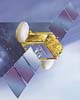
The successful launch Thursday of India's heaviest satellite from spaceport of Kourou in French Guyana may have boosted the country's space research efforts to yet another level, but it has also lifted the spirits of at least three Direct-To-Home televisions broadcasters, one of which has been waiting for years to launch its services in India. |
|
|

|
|
|
|
|
|
|
|
|
|
|
|
| The content herein, unless otherwise known to be public domain, are Copyright 1995-2006 - SpaceDaily.AFP and UPI Wire Stories are copyright Agence France-Presse and United Press International. ESA PortalReports are copyright European Space Agency. All NASA sourced material is public domain. Additionalcopyrights may apply in whole or part to other bona fide parties. Advertising does not imply endorsement,agreement or approval of any opinions, statements or information provided by SpaceDaily on any Web page published or hosted by SpaceDaily. Privacy Statement |