|
 |
 |
 |
 |
 |
 |
 |
 |

 |
ESA And Inmarsat Sign Innovative Alphasat Satellite Contract
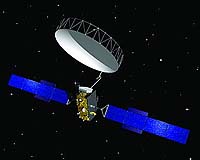
Paris, France (ESA) Nov 26, 2007 ESA and Inmarsat Global announce on Friday 23 November in Paris the formal signature of the contract for Alphasat satellite, one of the world's largest telecommunications satellites. The Alphasat programme is a major cooperation between the public and private sectors. With Alphasat, Inmarsat will be the first commercial customer for the Alphabus platform, the new European high-power telecommunications platform jointly developed by Astrium and Thales Alenia Space and initiated by a partnership between ESA and CNES (Centre National d'Etudes Spatiales) as a coordinated European response to the increased market demand for larger telecommunication payloads, for new broadband, broadcasting and mobile communications services. The Alphabus Alphasat programme represents an expenditure of 440 million euros by 16 ESA Member States. Under the development schedule, Alphasat will be available for launch in 2012. Positioned at 25 degrees East, providing extended coverage to Africa, Europe, the Middle-East and parts of Asia , Alphasat will supplement the existing Inmarsat satellite constellation and offer the opportunity for new and advanced services. Astrium Satellites is the industrial prime contractor for the development of the satellite, including its advanced L-Band mission, which will augment the successful services already being offered by Inmarsat's Broadband Global Area Network (BGAN). Key to the implementation of this payload is the advanced Integrated Processor, being developed by Astrium Satellites in the UK, which will provide payload flexibility enabling full coverage reconfiguration and flexible power allocation. Thanks to this increased efficiency of spectrum use and payload flexibility the Alphasat will further enable robust communications in crisis and disaster emergencies, allowing potential connection of houses, schools and businesses in remote locations and communications links for governments with dispersed populations and improve essential voice and data communications for a wide range of industry sectors such as media, maritime, oil and gas. For this application, the flexibility of the Alphabus platform design will be demonstrated by implementing a 'geomobile configuration' with a 90 degree change to the satellite flight orientation and a large deployable reflector (12 metres in diameter). In addition to the Inmarsat payload, Alphasat will also carry three ESA-provided Technology Demonstration Payloads (TDPs): an advanced star tracker using active pixel technology, an optical laser terminal for geostationary to low-Earth orbit communication at high data rates, and a dedicated payload for the characterisation of transmission performance in the Q-V band in preparation for possible commercial exploitation of these frequencies. A fourth TDP for space environments and effects monitoring is also under discussion.
Background Information The Alphabus/Alphasat activities of ESA are implemented within the frame of element 8 of the ARTES programme which is worth about 440 million euros in terms of to-date subscriptions. The following sixteen countries contribute to this programme: Austria, Belgium, Canada, Finland, France, Germany, Ireland, Italy, Luxembourg, Netherlands, Norway, Portugal, Spain, Sweden, Switzerland and the United Kingdom. For Alphasat this platform is utilised at the lower end of its capabilities, but the Alphabus is capable of supporting missions with more than 8 tonne launch mass and 18 kilowatt payload power. Whilst being a new platform development, the Alphabus is a careful blend of core technologies resulting from the extensive heritage of the two industrial partners with the inclusion of well proven new technologies where deemed appropriate. Community Email This Article Comment On This Article Related Links Centre National d'Etudes Spatiales (CNES) Space Technology News - Applications and Research
 Dude, Big Screen TVs, Flexible Electronics And Surfboards Made From Same New Material
 Cambridge, UK (SPX) Nov 22, 2007
There is nothing new about combining two materials to make a composite material with more desirable properties than the originals. Fibreglass has been a mainstay of the marine industry for decades and the construction industry is built on reinforced concrete. Now carbon nanotubes (CNT) are getting in on the act with nanotechnologists working out how to grow nanotube reinforcements for polymers in an ideal manner. |
|
|

| The content herein, unless otherwise known to be public domain, are Copyright 1995-2007 - SpaceDaily.AFP and UPI Wire Stories are copyright Agence France-Presse and United Press International. ESA Portal Reports are copyright European Space Agency. All NASA sourced material is public domain. Additional copyrights may apply in whole or part to other bona fide parties. Advertising does not imply endorsement,agreement or approval of any opinions, statements or information provided by SpaceDaily on any Web page published or hosted by SpaceDaily. Privacy Statement |