|
 |
 |
 |
 |
 |
 |
 |
 |

 |
ESA And Avanti To Collaborate On HYLAS
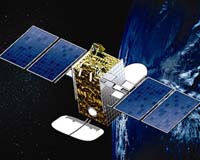
London, England (SPX) May 15, 2006 ESA and Avanti Screenmedia Group announced Monday they have signed a contract to develop the Highly Adaptable Satellite system. Scheduled for launch in 2008, HYLAS will be a hybrid Ka Band/Ku Band spacecraft providing broadband Internet access and high-definition television services to European customers in 22 countries. It will occupy a geostationary orbit a 33.5 degrees west longitude. Its expected lifetime is 15 years. The satellite's innovation will be its high-gain Ka Band spot beams, which will allow up to eight simultaneously active spots - equivalent to more than 40 conventional 33 megahertz transponders. The HYLAS broadband payload will be able to handle from 150,000 to 300,000 simultaneous users. The contract covers development of the most innovative elements of the new system. EADS Astrium will build HYLAS. ESA will contribute 34 million Euros ($44 million) toward a total estimated project cost of 120 million Euros ($154 million). The satellite will have a launch mass of about 2,100 kilograms (4,600 pounds) and beginning-of-life power of 3.5 kilowatts. HYLAS will be a moderate-sized satellite that allows the scalable introduction of new enhanced services with limited technical and financial risk, the two organizations said in a statement. ESA and Avanti will develop the novel payloads based on the combined use of EADS Astrium's Limited General Flexible Payload technology and TSAT Flexible Traveling Wave Tubes, allowing efficient assignment of satellite power and spectrum to each spot as a function of its respective traffic demand, the statement continued. The satellite's two flexible Ku Band transponders will allow distribution and broadcast of a range of HDTV programs for Avanti Screenmedia customers over a large area of the European continent. Avanti's intended ground segment will be based on ESA-supported standards known as the DVB family (DVB S-S2/DVB RCS). Community Email This Article Comment On This Article Related Links Avanti EADS Space Satellite-based Internet technologies
 Polar Explorers Use Satellite Broadband To Stay In Touch
 Paris (ESA) May 09, 2006
A team of young explorers from the Climate Change College are on a ten day field trip, participating in ESA's CryoSat validation experiment on the Greenland Ice Sheet. To stay in touch, the team is using Inmarsat's Broadband Global Area Network (BGAN), a technology development supported by ESA. |
|
|

| The content herein, unless otherwise known to be public domain, are Copyright 1995-2006 - SpaceDaily.AFP and UPI Wire Stories are copyright Agence France-Presse and United Press International. ESA PortalReports are copyright European Space Agency. All NASA sourced material is public domain. Additionalcopyrights may apply in whole or part to other bona fide parties. Advertising does not imply endorsement,agreement or approval of any opinions, statements or information provided by SpaceDaily on any Web page published or hosted by SpaceDaily. Privacy Statement |