|
 |
 |
 |
 |
 |
 |
 |
 |

 |
EO Sat Armada Helps Climatologists Fine Tune Long Range Forecasts
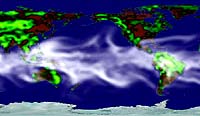
Greenbelt - Jan. 25, 2001 Weather prediction is hard enough. But what are the possibilities for predicting events related to weather? With new tools being developed at NASA's Goddard Space Flight Center in Greenbelt, Md., and NASA's ever increasing suite of Earth observations, scientists just might be on the road to estimating future weather-related incidents. A recent real world example suggests just how valuable this kind of information could be. Following the devastating season of wildfires in the western United States, many questions remain. Could officials have predicted the conditions for the severity of last summer's fire season, and therefore planned differently? At Goddard, experts are developing a system that someday soon might be useful in making those predictions. Oceanographer Dr. David Adamec and a team of earth scientists and others are using satellite measurements and conventional temperature readings of the oceans to drive an advanced computer simulation depicting seasonal to annual changes in the land and atmosphere. The goal of the research is to use the model to forecast real world, short-term climate trends. "We've essentially constructed a climate in cyberspace," said Adamec. "With the kind of dedicated digital horsepower at our disposal, this model goes far beyond anything available to the desktop world." Adamec says the simulation churns its digital winds and pelts the electronic ground with simulated rain inside the heart of a Cray T3E supercomputer. Although some years old now, NASA's T3E is still one of the fastest systems in the world. "The sheer speed at which we are able to run the model on the Cray T3E allows for advances in climate research," says Adamec. Performing billions of calculations per second, the system simulates the complex processes that produce short-term climate changes. The resulting images and data provide clues as to possible scenarios for seasonal and short-term climate trends. "It's a pro-active approach toward short-term global climatological research," he said. Adamec's team focuses on the model's interconnectedness of the atmosphere, ocean and land. By combining climatological interactions in an environment that can be fully controlled, the researchers can examine the Earth's climate and seasonal behavior in detail. One of the most powerful aspects of the work is the ability to change conditions to suit experimental needs. This ability has allowed them to use the conditions leading to last summer's fires as a test case for their model. Using actual ocean data during the conflagrations, Adamec's team looked to see if their computer model arrived at the same conclusion as the events in the real world. Often, summer rains begin from evaporating soil moisture. Since a layer of moist air tends to remain closer to the ground than a layer of dryer air, it is more easily heated during the day due to its proximity to the warm ground. Eventually, that heated, moist air rises and produces rain clouds. But with last year's La Ni�a spring, part of that cycle was interrupted. The soil did not contain much moisture going into the summer due to a dry spring. When soil moisture is limited, the mechanism for summertime precipitation is deficient, and the result is a season of drought that sets prime conditions for fires. What did NASA's supercomputer predict? Using data prior to the fire season, the model essentially concluded that dry conditions would persist through the season. While in this instance the model was right on, Adamec says it is still a long way from completion. "The model still cannot reliably predict complex climate changes into the future to the degree that state or federal governmental agencies and communities can set their calendars and budgets," he said. "But with recent, stunning advances in computer technology, as well as continuing developments in using satellites to acquire new data, we are definitely making progress toward that end." Adamec's team hopes their work will lead to not only highly precise methods for climate prediction, but also tools for understanding how it works at the most sophisticated levels. Research into the forces that drive short and long-term changes to the land and atmosphere are part of NASA's Earth Science Enterprise, a research program designed to study the Earth's land, oceans, air, ice and life as a total system. Community Email This Article Comment On This Article Related Links Virtual Rain: New Tools For Climate Science NASA's high-performance scientific computing facility SpaceDaily Search SpaceDaily Subscribe To SpaceDaily Express Dirt, rocks and all the stuff we stand on firmly
 Magnetic Reconnection Region Larger Than 2.5 Million Km Found In The Solar Wind
 Paris (ESA) Jan 12, 2006
Using the ESA Cluster spacecraft and the NASA Wind and ACE satellites, a team of American and European scientists have discovered the largest jets of particles created between the Earth and the Sun by magnetic reconnection. This result makes the cover of this week's issue of Nature. |
|
|

|
|
|
|
|
|
|
|
|
|
|
|
| The content herein, unless otherwise known to be public domain, are Copyright 1995-2006 - SpaceDaily.AFP and UPI Wire Stories are copyright Agence France-Presse and United Press International. ESA PortalReports are copyright European Space Agency. All NASA sourced material is public domain. Additionalcopyrights may apply in whole or part to other bona fide parties. Advertising does not imply endorsement,agreement or approval of any opinions, statements or information provided by SpaceDaily on any Web page published or hosted by SpaceDaily. Privacy Statement |