|
 |
 |
 |
 |
 |
 |
 |
 |

 |
EGNOS System Delivered To ESA By Industry
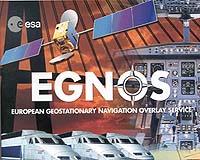
Paris, France (SPX) Jun 22, 2005 A key step for satellite navigation in Europe was achieved on 16 June 2005, with the formal completion of the technical qualification of the European Geostationary Navigation Overlay Service (EGNOS) and the acceptance of the EGNOS system delivered to ESA. This formal review, called the Operational Readiness Review (ORR), marked the completion of more than 8 years of intensive work by ESA and European industry. The ORR involved the acceptance of the EGNOS system delivered to ESA by an industrial consortium lead by Alcatel Space with more than forty European companies. EGNOS is a joint project of the European Space Agency (ESA), the European Commission (EC) and Eurocontrol - the European Organisation for the Safety of Air Navigation. ESA is in charge of the system development and technical qualification. EGNOS is Europe�s contribution to the first stage of the global navigation satellite system (GNSS), paving the way for Galileo, the first civil complete satellite navigation system. Three special EGNOS satellites located in geostationary orbit above Europe transmit a GPS-like signal that improves the GPS accuracy down to 1 to 2 metres. Service guarantee and integrity information is also provided. EGNOS measured performances are beyond initial expectations, another demonstration of the excellence of the European engineers and technology. More than 60 international experts from ESA gathered in Toulouse during May 2005. Eurocontrol, the Galileo Joint Undertaking and the EGNOS Operator and Infrastructure Group took part in this comprehensive review. Experts assessed whether the EGNOS system could be accepted as ready for operation. The focus was on several aspects such as the functional qualification of the system and its operability, the stability of the system in its real environment, the system performance and compliance with the requirements and Safety and Product assurance issues including the qualification of the software and the completeness of the deliverables. This review concluded earlier work carried out in the previous project phases, such as the System Preliminary Design Review in November 1998, a Critical Design Review in January 2002 followed by the EGNOS Factory Qualification Review in January 2004. Today, the deployment of EGNOS is nearly complete, with around 30 Ranging and Integrity Monitoring Stations (RIMS) deployed in 21 countries; 4 Mission Control Centres (MCCs) deployed in Spain, Italy, UK and Germany; 6 Navigation Land Earth Stations (NLESs) deployed in Italy, France, Spain and the UK and some support facilities in Spain and France. Following this review, EGNOS initial operations can start through a contract with the European Satellite Service Provider (ESSP). By early 2006, when operational stability is expected to be reached, the EGNOS open service will be declared formally available to the general public over Europe for non safety-of-life applications, free of direct charges. Today, the general public can already receive the EGNOS signal on a test basis. Community Email This Article Comment On This Article Related Links Galileo Joint Undertaking (GJU) SpaceDaily Search SpaceDaily Subscribe To SpaceDaily Express GPS Applications, Technology and Suppliers
 Galileo GIOVEA Using Marotta Equipment For Its Propulsion Systems
 Cheltenham, England (SPX) Jan 09, 2006
Marotta UK is pleased to announce that it designed, developed and qualified equipment for the cold gas propulsion systems on board the Galileo GIOVE-A, part of Europe's Galileo navigation program, successfully launched by Surrey Satellite Technology (SSTL). |
|
|

| The content herein, unless otherwise known to be public domain, are Copyright 1995-2006 - SpaceDaily.AFP and UPI Wire Stories are copyright Agence France-Presse and United Press International. ESA PortalReports are copyright European Space Agency. All NASA sourced material is public domain. Additionalcopyrights may apply in whole or part to other bona fide parties. Advertising does not imply endorsement,agreement or approval of any opinions, statements or information provided by SpaceDaily on any Web page published or hosted by SpaceDaily. Privacy Statement |