|
 |
 |
 |
 |
 |
 |
 |
 |

 |
EADS Space Says MetOp Ready For Launch
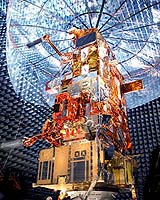
Paris, France (SPX) Jul 14, 2006 EADS Space announced Thursday that ESA's MetOp spacecraft is ready for its scheduled launch July 17 by Starsem aboard a Soyuz rocket from Baikonur Cosmodrome, Kazakhstan. EADS Space is the satellite's prime contractor and is responsible for three of the 11 onboard instruments. MetOp is the first in a series of three satellites built by EADS Space for ESA and EUMETSAT, Europe's weather satellite organization. Other partners include CNES in France and the U.S. National Oceanic and Atmospheric Administration, each of which is providing payload instruments. MetOp will become Europe's first polar-orbiting satellite dedicated to operational meteorology. It represents the European Union's contribution to a new cooperative venture with the United States. The venture will provide data to be used to monitor climate and improve weather forecasting. Two other satellites in the MetOp series will be flown at 4.5-year intervals to ensure an operational service over at least 14 years. These spacecraft will remain in storage until just prior to their respective launches, when they will receive their final instrumentation. MetOp - formally called MetOp-A - will carry 11 different instruments designed to enable the satellite to achieve its principal mission objectives: making meteorological observations and monitoring climate change. The spacecraft also will support search and rescue efforts and will monitor charged particles in the low-Earth-orbit environment. EADS Space has managed an industrial team including more than 50 contractors. The company is responsible for the satellite system and the satellite service module, which is based on the platform developed at its Toulouse, France, facility for observation satellites. The platform already has flown 11 times successfully for various missions, including SPOT, ERS, Envisat and Helios. EADS Space built the MetOp payload module in Germany. It accommodates the instruments and the associated monitoring and control subsystems. The PLM is based on an Envisat payload module also built by EADS Space. The EADS Space instruments on Metop include the Advanced Scatterometer, the GNSS Receiver for Atmospheric Sounding, and the Microwave Humidity Sounder. ASCAT is an active radar instrument that measures wind speed and direction over the open sea. It also provides data for ice and snow coverage as well as surface moisture. ASCAT measurements are independent of daylight and clouds, a characteristic that is particularly useful in Earth's polar regions. ASCAT will scan two 500-kilometer (310-mile) wide corridors and can provide almost global coverage within 24 hours. GRAS, built by Saab Ericsson, is a receiver for the signals from the U.S. Global Positioning System. The signals are affected by the atmosphere of the Earth, and after processing provide atmospheric data such as temperature, water vapor and pressure. GRAS also provides precise navigation data to support the orbit determination of the satellite. The MHS was designed and built by EADS Space in Portsmouth, England, for EUMETSAT. MHS scans Earth's atmosphere to measure emitted radiation in various spectra bands and from this can determine the water vapor content (clouds, precipitation and humidity) at various altitudes. The first MHS instrument was launched May 19, 2005, aboard the NOAA-N polar-orbiting satellite. Community Email This Article Comment On This Article Related Links MetOp EADS Space Starsem ESA Weather News at TerraDaily.com
 Summation Research Wins Contract for Critical Weather Satellite Ground Equipment
 Melbourne FL (SPX) Jul 12, 2006
Summation Research, Inc. has announced that they have been selected by the National Oceanic and Atmospheric Administration (NOAA) to provide advanced Multi-Functional Satellite Demodulators in support of the Geostationary Operational Environmental Satellites (GOES) weather satellite system. The contract award, once fully deployed, is in excess of $400,000. |
|
|

| The content herein, unless otherwise known to be public domain, are Copyright 1995-2006 - SpaceDaily.AFP and UPI Wire Stories are copyright Agence France-Presse and United Press International. ESA PortalReports are copyright European Space Agency. All NASA sourced material is public domain. Additionalcopyrights may apply in whole or part to other bona fide parties. Advertising does not imply endorsement,agreement or approval of any opinions, statements or information provided by SpaceDaily on any Web page published or hosted by SpaceDaily. Privacy Statement |