|
 |
 |
 |
 |
 |
 |
 |
 |

 |
Droughts And Reservoirs: Finding Storage Space Underground
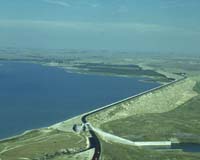
Boulder CO (SPX) Sep 19, 2006 Odd as it sounds, in some places the smartest way to safeguard the water supply is to let it drain out of the reservoirs and soak into the ground. That's what been discovered in local water shortages in Kansas, Oklahoma, and New Mexico - all of which could be microcosms of water shortage issues looming throughout the Western U.S. In these three cases - Cedar Bluff Reservoir (Hays, KS), Optima Lake, (Guymon, OK), and Storrie Lake (Las Vegas, NM) - water losses from evaporation are so high that they can accelerate water supply emergencies for farms and cities, explains Tom Brikowski, a professor of hydrology at the University of Texas at Dallas. Brikowski and Wayland Anderson, a Denver engineer, are presenting their work at the Geological Society of America conference on Managing Drought and Water Scarcity in Vulnerable Environments: Creating a Roadmap for Change. The meeting takes place 18-20 September at the Radisson Hotel and Conference Center in Longmont, Colorado. In the case of the City of Hays, the trouble starts 20 miles upstream at the Cedar Bluff Reservoir. Because of changes in farming practices, the reservoir gets only half the inflowing water it did when built in 1949. It now loses 75 percent of its inflowing water to evaporation. As a result, water losses most years now equal or exceed inflows. Reservoir releases were cut in 1979. "You get to the point where you can't afford to lose that much water," said Brikowski, "and your only other alternative is to store it underground." But how do you do that? In the case of Hays, nature had already provided for underground storage in the form of the Smoky Hill River aquifer. The aquifer has provided half the city's water supply for decades. Since the building of the Cedar Bluff reservoir, however, stream flow on top of it has dropped by 50 percent. That stream water recharged the wells, which, in turn, kept alive the town of Hays, Brikowski explains. At the behest of the City of Hays, Brikowski and Anderson created a detailed three-dimensional model of the sandy, gravelly ("alluvial") ground beneath the Smokey Hill River. Anderson analyzed the water balance of the reservoir. Next they simulated what had happened to the dropping water table, how much groundwater the aquifer could store, and how long a drought it could endure. "It's a clear case that the shut off of water (by the reservoir) limited how much water Hays could pump," said Brikowski. It also showed that by releasing water from that same reservoir they could kill two birds with one stone: recharge the aquifer and reduce the evaporation loss rate. According to Brikowski, "It was pretty hard to argue with the conclusion." They also found that by releasing reservoir water to recharge the Smoky Hill River aquifer, users could survive even the worst recorded drought with full production from municipal wells. "I think the City as a whole was quite happy," said Brikowski. By getting a better understanding of their water, the city can now avert seasonal water emergencies and no longer have to consider building hundreds of miles of pipeline to get water from other river basins. This story could replay in other places as well - especially where reservoirs are getting less inflow due to changing water uses or climate change. There's the city of Las Vegas, NM, only months away from evacuations this year after lack of snow over the winter left streams dry. It was only the annual monsoon season that saved them this year, said Brikowski. The water crisis is becoming an almost annual event as winter snow packs shrink and melt sooner each spring, probably as a consequence of global warming. "More efficient storage, perhaps in alluvial aquifers, represents the only real hope for a solution," Brikowski said. The same may eventually be the case for most of California, which relies heavily on the melting of snow pack high in the Sierra Nevada to feed streams and rivers through the summer. Global warming is expected to raise the snowline on those mountains and has already pushed spring earlier in the year. This means there is generally less snowmelt and it may not last the whole summer. The Optima Reservoir of the Oklahoma Panhandle is an extreme example. A dry lake, it loses 100 percent of its inflowing water to evaporation. Converting to subsurface storage may be the only way to store water. "It's not that in any of these places they've done anything wrong," Brikowski said. Rather, situations change and water management has to keep up to avoid supply problems. Underground storage, he said, is something to add to the water management toolbox. Community Email This Article Comment On This Article Related Links Converting from Surface to Groundwater Storage to Survive Long-Term Drought Geological Society of America Water, Water Everywhere and Not A Drop To Drink... Water News - Science, Technology and Politics
 Concrete Measures Called For Sustainable Water Use
 Beijing (XNA) Sep 12, 2006
Chinese Vice-Premier Zeng Peiyan said on Sunday that the government will make greater efforts to promote water efficiency and control widespread water pollution. He made the remarks at the opening of the Fifth World Water Congress that attracted over 3,000 policy makers, experts and business leaders from across the world. |
|
|

| The content herein, unless otherwise known to be public domain, are Copyright 1995-2006 - SpaceDaily.AFP and UPI Wire Stories are copyright Agence France-Presse and United Press International. ESA PortalReports are copyright European Space Agency. All NASA sourced material is public domain. Additionalcopyrights may apply in whole or part to other bona fide parties. Advertising does not imply endorsement,agreement or approval of any opinions, statements or information provided by SpaceDaily on any Web page published or hosted by SpaceDaily. Privacy Statement |