|
 |
 |
 |
 |
 |
 |
 |
 |

 |
Draper Lab Brings A New Age Of Automation To ISS
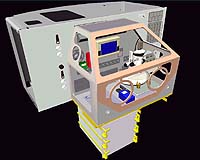
Boston - Jun 22, 2003 Early in the morning June 10, NASA ushered in a new era in International Space Station payload operations when payload controllers at the Marshall Space Flight Center (MSFC) installed the first Timeliner automation scripts. The execution of the scripts automated the Microgravity Science Glovebox (MSG) Startup and Shutdown Notification command sequences. Timeliner scripts significantly enhance science productivity by automating tasks previously performed by the station crew or MSFC ground operators. Future space station uses for Timeliner include automation of additional payload command and control, checkout and control of vehicle sub-systems and automation of updates to station firmware. Timeliner originally had been scheduled to become operational in October 2002, but the MSG payload had a failed power supply at that time, which delayed the implementation of Timeliner until recently. Developed by Draper Laboratory, Timeliner executes programmed sequences of activities either autonomously or through interactive control with the astronauts or ground operators. It can run pre-defined "scripts" of procedures and allows intervention by system operators in real time through commands to install, remove, start, stop, step ahead, or resume scripts. The Timeliner scripts cause actions to be taken not only on the basis of time, but also triggered by system events or complex dynamic conditions. Timeliner can execute multiple simultaneous sequences of operations, running up to 40 scripts in parallel. Timeliner is a modular system, consisting of a kernel and adaptors. The kernel is the core functionality of Timeliner and does not change across applications. Different adaptors have been developed that allow Timeliner to interface with a variety of operating systems, including the operating system of the International Space Station. Timeliner was originally developed by Draper in 1981 for use in simulating tasks performed by astronauts aboard the Space Shuttle. In 1992, Timeliner was selected by NASA as the user interface language for the space station, and it was installed on the space station�s Command and Control Processor and Payload Control Processor. A version of Timeliner also has been adapted for use on the space station�s Kibo Japanese Experiment Module, which is scheduled for launch on the space shuttle on the ISS 1J flight in May 2004. Draper received a patent on Timeliner in 1998. Community Email This Article Comment On This Article Related Links Draper Lab SpaceDaily Search SpaceDaily Subscribe To SpaceDaily Express Space Station News at Space-Travel.Com
 NASA Had No Choice But To Buy Soyuz Flights
 Washington DC (SPX) Jan 09, 2006
NASA's announcement last week that it will pay Roskosmos $43.6 million for a round-trip ride to the International Space Station this spring, and an equivalent figure for an as-yet-undetermined number of future flights to the station until 2012, represents the agency's acknowledgment that it had no alternative. |
|
|

| The content herein, unless otherwise known to be public domain, are Copyright 1995-2006 - SpaceDaily.AFP and UPI Wire Stories are copyright Agence France-Presse and United Press International. ESA PortalReports are copyright European Space Agency. All NASA sourced material is public domain. Additionalcopyrights may apply in whole or part to other bona fide parties. Advertising does not imply endorsement,agreement or approval of any opinions, statements or information provided by SpaceDaily on any Web page published or hosted by SpaceDaily. Privacy Statement |