|
 |
 |
 |
 |
 |
 |
 |
 |

 |
Dragons Of The Air: Pterosaurs Flew With Smart Wings Boulder
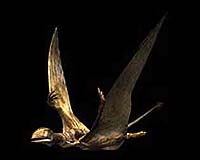
Colorado - Mar 16, 2004 These are the images of which nightmares are made: ancient pterosaurs darkening Earth's skies above the heads of dinosaurs during the Mesozoic era 225 million to 65 million years ago. Until now little has been understood about how these creatures, ranging in size from 0.5 ounces to 150 pounds, with wing spans as wide as a Lear jet, took flight. Research by an unusual partnership of paleontologist and aeronautical engineer now reveals these dragons of the air could teach today's aircraft designers a thing or two. In Posture, Locomotion, and Paleoecology of Pterosaurs, recently published by the Geological Society of America (Special Paper 376), Sankar Chatterjee and R. J. Templin shed new light on what they call pterosaurs' "smart wings." Using 10 genera of pterosaurs, ranging in wing span from 15 inches to 34 feet, and aerodynamic models based on aircraft and helicopter momentum theory, Chatterjee and Templin reached startling new conclusions about the anatomy, terrestrial locomotion, and control system of pterosaur wings and their flight performance. Pterosaurs have a unique framework for the wing membrane which is supported by the forelimb and one hyper-elongated fourth finger. Three small inner fingers enjoyed freedom of motion. According to the authors, pterosaurs evolved two basic wing shapes over the 160 million years during which they ruled Earth's skies. Early pterosaurs or "rhamphorhynchoids" had broad bat-like wings with the wing membrane attaching to the ankle. In later "pterodactyloids," the wings were narrower and anchored near the knee joints. According to Chatterjee, Paul Whitfield Horn Professor of Geology at Texas Tech University, "The fourth finger could be moved backward considerably, morphing the wing shape to change speed. Wing anatomy also suggests they functioned as sophisticated flight sensor devices." Compared with a fixed-wing aircraft, a pterosaur wing is an incredibly complicated structure of hair, skin, muscles, tendons, blood vessels, and nerve tissue. Beneath the hairy outer covering is a three-layered structure of fibers (actinofibrils), muscles, and a fine network of blood vessels and sensory nerves. The fibers confer some stiffness and structural integrity, probably to control surface curvature for aerodynamic efficiency and to prevent billowing and tearing during flight. These fibers functioned like the ribbings of an umbrella for folding and unfolding the wings when walking or flying. The authors speculate that the wing acted as a sensory organ during flight, providing feedback to the inner ear, the control system of wing movement. When a pterosaur's flight was disturbed by turbulence, movement was detected by the highly enlarged semicircular canals of the inner ear. Compensations were then made by fine adjustments of the wings, and normal flight was resumed. "Pterosaurs could respond to constantly varying conditions using their sensors to monitor pressure variations over the entire surface of the wing," says co-author Templin, retired head of the Canadian National Research Council's Aerodynamics Laboratory. "They could morph their wing shape to exploit flight conditions and control speed. Perhaps one day our aircraft may fly more like pterosaurs, cruising over oceans on convertible wings to save energy and achieve better performance." Templin also notes that the wingtips appear to be rounded to avoid stalling, a trend seen among new generations of racing yacht sail. On land pterosaurs walked on all fours, like primates, with wings folded tightly against the body. From this position, they could stand on their rear legs and run in an upright posture during takeoff and landing. Traditionally pterosaurs have been portrayed as gliders cruising slowly over the ocean currents. Chatterjee and Templin's computer analyses, however, indicate that pterosaurs achieved the entire complex flying repertoires of modern birds--hovering, flapping, gliding, and soaring--depending on their size. All but the largest were capable of steady powered flight at speeds up to about 15 m/s (about 33 mph). The largest, Quetzalcoatlus, though an excellent glider, appears to have been incapable of level sustained flight, but could have benefited from V-formation flight, as do large modern migrating birds. Pterosaurs became extinct at the end of the Cretaceous. They met the same fate as dinosaurs and other organisms when one or more asteroids crashed into the Earth, accompanied by the spectacular Deccan volcanism that had devastating ecological effects. Posture, Locomotion, and Paleoecology of Pterosaurs Sankar Chatterjee and R.J. Templin Geological Society of America Special Paper 376 68 Pages ISBN 0-8137-2376-0 For more information click here Community Email This Article Comment On This Article Related Links Geological Society of America SpaceDaily Search SpaceDaily Subscribe To SpaceDaily Express Dirt, rocks and all the stuff we stand on firmly
 Magnetic Reconnection Region Larger Than 2.5 Million Km Found In The Solar Wind
 Paris (ESA) Jan 12, 2006
Using the ESA Cluster spacecraft and the NASA Wind and ACE satellites, a team of American and European scientists have discovered the largest jets of particles created between the Earth and the Sun by magnetic reconnection. This result makes the cover of this week's issue of Nature. |
|
|

| The content herein, unless otherwise known to be public domain, are Copyright 1995-2006 - SpaceDaily.AFP and UPI Wire Stories are copyright Agence France-Presse and United Press International. ESA PortalReports are copyright European Space Agency. All NASA sourced material is public domain. Additionalcopyrights may apply in whole or part to other bona fide parties. Advertising does not imply endorsement,agreement or approval of any opinions, statements or information provided by SpaceDaily on any Web page published or hosted by SpaceDaily. Privacy Statement |