|
 |
 |
 |
 |
 |
 |
 |
 |

 |
Dragon Storms And Tiger Stripes: Scientists Stunned By New Saturn Data
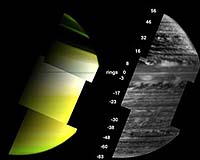
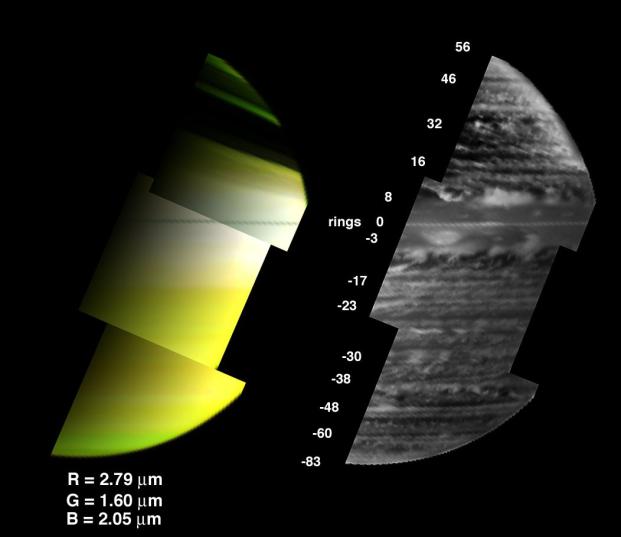
Cambridge, England (AFP) Sep 05 2005 New data sent back by the Cassini space probe has left scientists beguiled by Saturn's seething clouds of gas, the beauty and unexpected turbulence of its rings and the diversity of its moons, a conference heard on Monday. "The complexity is just dumbfounding," Dennis Matson, senior scientist with the Cassini project, told a meeting in Cambridge of top US and European specialists on the solar system. The last of the big-ticket explorations of the outer planets begun by the United States four decades ago, Cassini arrived at Saturn in mid-2004 on a four-year mission to survey the ringed giant and its satellites. In December, the three billion dollar (2.4 billion euros) mission sent down the European probe Huygens on a suicide plunge to Titan, a moon whose bizarre photochemistry -- a smog of methane and other carbon compounds -- makes it one of the most puzzling objects in the system. Extraordinary pictures from Cassini, unveiled at the Cambridge meeting, had many astronomers gasping in amazement at details that formerly they could only guess at, through Earth-bound telescopes or a snatched glance by NASA's Voyager spacecraft. One surprise is the sheer diversity of the clouds lurking in the depths of the atmosphere of Saturn, a gas giant like its slightly larger sibling, Jupiter. "Unlike the hazy, broad, global bands of clouds regularly seen in Saturn's upper atmosphere, many of the deeper clouds appear to be isolated, localized features," said Kevin Baines, a member of the visual and infrared mapping spectrometre team at NASA's Jet Propulsion Laboratory. "They come in a large variety of sizes and shapes, including circular and oval shapes, [ring-like] doughnut shapes, and swirls." These clouds are deep in the atmosphere, about 30 kilometers (19 miles) underneath the upper clouds usually seen on Saturn. They also behave differently from those in the upper atmosphere and consist of different materials, JPL said. They are made of either ammonium hydrosulphide or water, but not ammonia -- the chemical generally thought to comprise the upper clouds. Saturn's roiling, suffocating atmosphere is also inhabited by huge thunderstorms the size of an Earth-sized continent. One cataclysmic event spotted by Cassini's cameras was named "Dragon Storm" because it coincidentally took the shape of a dragon, Matson said. Saturn's most famous possession -- the rings, first spotted by Galileo in 1610 according to legend -- is in a continuous state of evolution, the Cassini team reported. Far from being a region of circling coherence and tranquility, the rocky debris of the seven rings bump and clump together and pull part, enslaved in the gravitational grip of their master and ripped by passing moons. The A ring -- the outermost -- "is primarily empty space," as debris becomes clustered, gets torn apart and then reassembled by Saturn's gravitational forces. Part of the D ring -- the ring closest to Saturn -- has become dimmer and moved inward, toward Saturn, by about 200 kilometers (125 miles), since it was observed by Voyager in 1980 and 1981. The ring system "is an absolutely dynamic region. The rings are constantly moving, with the interplay of gravity and possibly magnetic fields," said Carolyn Porco of the Space Science Institute at Boulder, Colorado. Another big surprise is that a spiral ring encircles the planet like a coiled spring. This "spiral arm" exists around the F ring, and could be the consequences of moons that, themselves tortured by Saturn's giant gravity, spew out material. This raises the question that the F ring might be unstable or even short-lived. As for Saturn's 46 moons, Enceladus has joined Titan as a source of nagging speculation as to how they were formed -- a process that sheds light on the birth of Earth and the other rocky planets that orbit close to the Sun. The south pole of this ice-covered satellite is streaked with deep, long cracks nicknamed "tiger stripes." Thermal sensors show this area to be a hot spot, albeit still very cold by Earth standards, and with a localised atmosphere of water vapour. The implication is that there is some warm, sub-surface ocean. But how could this happen? Enceladus is in theory too tiny to develop enough internal heat to do this. The five-day conference gathers members of the American Astronomical Society and Britain's Royal Astronomical Society (RAS). It runs until Friday. CommunityEmail This Article Comment On This Article Related Links SpaceDaily Search SpaceDaily Subscribe To SpaceDaily Express Explore The Ring World of Saturn and her moons Jupiter and its Moons The million outer planets of a star called Sol News Flash at Mercury
 Cassini Images Halo Around Titanic Moon Off Saturn
 Pasadena CA (SPX) Dec 27, 2005
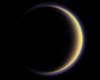
With its thick, distended atmosphere, Titan's orange globe shines softly, encircled by a thin halo of purple light-scattering haze. |
|
|

| The content herein, unless otherwise known to be public domain, are Copyright 1995-2006 - SpaceDaily.AFP and UPI Wire Stories are copyright Agence France-Presse and United Press International. ESA PortalReports are copyright European Space Agency. All NASA sourced material is public domain. Additionalcopyrights may apply in whole or part to other bona fide parties. Advertising does not imply endorsement,agreement or approval of any opinions, statements or information provided by SpaceDaily on any Web page published or hosted by SpaceDaily. Privacy Statement |