|
 |
 |
 |
 |
 |
 |
 |
 |

 |
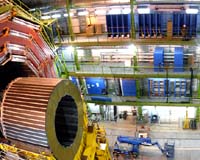
Down With Physics: Giant CMS Magnet Goes Underground At CERN
Batavia IL (SPX) Mar 05, 2007 Scientists of the US CMS collaboration joined colleagues around the world in announcing today (February 28) that the heaviest piece of the Compact Muon Solenoid particle detector has begun the momentous journey into its experimental cavern 100 meters underground. A huge gantry crane is slowly lowering the CMS detector's preassembled central section into place in the Large Hadron Collider accelerator at CERN in Geneva, Switzerland. At 1,950 metric tons, the section, which contains the detector's solenoid magnet, weighs as much as five jumbo jets and is 16 meters tall, 17 meters wide and 13 meters long. Its descent is expected to take about 10 hours. "This is a challenging feat of engineering, as there are just 20 centimeters of leeway between the detector and the walls of the shaft," said CERN physicist Austin Ball, technical coordinator of CMS. "The detector is suspended by four massive cables, each with 55 strands, and attached to a step-by-step hydraulic jacking system, with sophisticated monitoring and control to ensure the object does not sway or tilt." Of the CMS collaboration's approximately 1500 physicists, about one-third are U.S. scientists. The Department of Energy's Fermi National Accelerator Laboratory is the host laboratory for US CMS, and U.S. scientists have designed, built and delivered to CERN several key elements of the CMS detector. Currently, U.S. contributions to CMS are more than 98 percent complete. A U.S. team from Fermilab recently carried out a precision mapping of the magnetic field of the CMS solenoid magnet that is being lowered today. By observing the curvature of the paths of charged particles in the magnetic field, physicists will calculate the energy of particles flying out from billions upon billions of proton-proton collisions that will occur inside the detector. "We are proud of our contribution to the extraordinary international scientific endeavor now taking shape at the LHC," said Associate Director for High Energy Physics at DOE's Office of Science Dr. Robin Staffin. "We applaud the engineering tour de force of today's CMS milestone at CERN. Each step forward at the LHC experiments and the accelerator brings us closer to the start of scientific operations and to breakthroughs in our understanding of the physics of the universe." Experimenters have already lowered the first seven of 15 pieces of the CMS detector, with the first piece arriving in the experimental cavern on November 30, 2006. The giant section descending today marks the halfway point in the lowering process, with the last piece scheduled to make its descent in summer 2007. Particle detectors are typically assembled underground, where the accelerator tunnel is located. CMS has broken with tradition by starting assembly before completion of the underground cavern, taking advantage of a spacious surface assembly hall to preassemble and pretest the detector's myriad components and systems. "This is an impressive milestone in the complex installation of the CMS particle detector," said Dr. Moishe Pripstein, Program Director at the National Science Foundation. "It augurs well for being ready for first beam collisions at the LHC. We are delighted that scientists from U.S. universities and from Fermilab are making substantial technical contributions to this grand international collaboration and look forward to exciting results in the next several years." Physicists are preparing the CMS detector and its sister detector, ATLAS, to take data at CERN's Large Hadron Collider, where scientists predict that they will make fundamental discoveries about the universe, using very-high-energy proton collisions. Beyond revealing a new world of unknown particles, the LHC experiments could explain why those particles exist and behave as they do. They could discover the origins of mass, shed light on dark matter, uncover hidden symmetries of the universe, and possibly find extra dimensions of space. Community Email This Article Comment On This Article Related Links Powering The World in the 21st Century at Energy-Daily.com Our Polluted World and Cleaning It Up China News From SinoDaily.com Global Trade News The Economy All About Solar Energy at SolarDaily.com Civil Nuclear Energy Science, Technology and News Understanding Time and Space
 Milky Way Black Hole May Be a Colossal Particle Accelerator
 Tucson AZ (SPX) Mar 01, 2007
Scientists were startled when they discovered in 2004 that the center of our galaxy is emitting gamma rays with energies in the tens of trillions of electronvolts. Now astrophysicists at The University of Arizona, Los Alamos National Laboratory and the University of Adelaide (Australia) have discovered a mechanism that might produce these high-energy gamma rays. |
|
|

| The content herein, unless otherwise known to be public domain, are Copyright 1995-2006 - SpaceDaily.AFP and UPI Wire Stories are copyright Agence France-Presse and United Press International. ESA PortalReports are copyright European Space Agency. All NASA sourced material is public domain. Additionalcopyrights may apply in whole or part to other bona fide parties. Advertising does not imply endorsement,agreement or approval of any opinions, statements or information provided by SpaceDaily on any Web page published or hosted by SpaceDaily. Privacy Statement |