|
 |
 |
 |
 |
 |
 |
 |
 |

 |
Double Star Mission Extension Approved By ESA
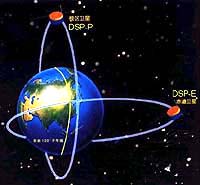
Paris (ESA) May 31, 2005 On 10 May 2005, the ESA Science Programme Committee (SPC) approved the extension of the Double Star mission for a period of 17 months, pushing back the end date from July 2005 to December 2006. The Double Star mission comprises two spacecraft to investigate magnetospheric global processes and their responses to interplanetary disturbances, in particular in conjunction with the Cluster mission that was recently extended from December 2005 to December 2009. The first spacecraft, TC-1, was launched on 29 December 2003 and the second one, TC-2, on 25 July 2004, both on board Chinese Long March 2C rockets. TC-1 was injected into an equatorial orbit of 570 x 79 000 km altitude (geocentric apogee/perigee: 13.4/1.09 RE) with a 28� inclination and TC-2 into a polar orbit of 700 x 38 000 km altitude (geocentric apogee/perigee: 7.0/1.11 RE). The Double Star Programme (DSP) was first proposed by China in March 1997. It is the first project of international collaboration between China and ESA. Under the present collaboration agreement, ESA committed itself to contribute to the construction/refurbishment and pre-integration of eight European instruments, acquisition of data for 4 hours per day and coordination of scientific operations for the European instruments. China's contribution includes the two spacecraft buses, eight scientific experiments, launch and spacecraft operations. The orbits have been designed to complement the Cluster mission by maximizing the time when both Cluster and Double Star are in the same scientifically interesting regions. The two missions allow simultaneous observations of the Earth's magnetosphere from six points in space. To facilitate the comparison of data, half of the Double Star payload (with the exception of the NUADU instrument) is made up of spares or duplicates of Cluster experiments; the other half consists of new Chinese instruments. The first year of DSP operations, in combination with Cluster, has brought many new results concerning the boundaries of the magnetosphere. We can see for the first time, the evolution of structures and physical processes at small scales, within the Cluster tetrahedron, and then at large scales with Cluster and Double Star.
Scientific Highlights of the nominal mission Three scientific highlights obtained during the nominal phase of the mission will now be briefly underlined.
Magnetic reconnection found preferably around the subsolar point
Observational first on ring current imaging
These data are used to better understand the overall morphology of the ring current and its behaviour during geomagnetic storms. Species-dependent deceleration at the Earth's bow shock revealed
Analysis of such observations by TC-1 showed that the deceleration of H+ ions is half that of the deceleration of He++ ions. These observations will help to model shocks, not only in front of the Earth's magnetosphere, but also in front of other planets and astronomical objects
Why an extension? Due to orbit mechanics and the fact that some processes (like geomagnetic storms) occur only very rarely and at varying locations, during the first year only a few good conjunctions with Cluster could be exploited. More observations of these key magnetospheric processes (reconnection for example) are essential to fully understand them. The approved extension of 1.5 years will allow the number of conjunctions to be doubled on the dayside of the magnetosphere and to be tripled in the magnetotail.
The other scientific arguments to extend the Double Star mission are:
Email This Article Comment On This Article Related Links China National Space Administration Double Star Program at ESA SpaceDaily Search SpaceDaily Subscribe To SpaceDaily Express Dirt, rocks and all the stuff we stand on firmly
 Magnetic Reconnection Region Larger Than 2.5 Million Km Found In The Solar Wind
 Paris (ESA) Jan 12, 2006
Using the ESA Cluster spacecraft and the NASA Wind and ACE satellites, a team of American and European scientists have discovered the largest jets of particles created between the Earth and the Sun by magnetic reconnection. This result makes the cover of this week's issue of Nature. |
|
|

| The content herein, unless otherwise known to be public domain, are Copyright 1995-2006 - SpaceDaily.AFP and UPI Wire Stories are copyright Agence France-Presse and United Press International. ESA PortalReports are copyright European Space Agency. All NASA sourced material is public domain. Additionalcopyrights may apply in whole or part to other bona fide parties. Advertising does not imply endorsement,agreement or approval of any opinions, statements or information provided by SpaceDaily on any Web page published or hosted by SpaceDaily. Privacy Statement |