|
 |
 |
 |
 |
 |
 |
 |
 |

 |
Double Star Mission Extended
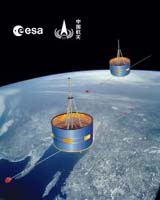
Paris, France (ESA) Nov 17, 2006 Earlier this month, ESA's Science Programme Committee (SPC) unanimously approved a nine-month extension of ESA's involvement in the China/ESA Double Star mission. Double Star is currently studying the Earth's magnetosphere - the natural protective shield surrounding our planet - and its interaction with the solar wind. The two Double Star satellites were launched in December 2003 and July 2004 respectively - a schedule that enabled them to operate alongside ESA's Cluster mission. Since then, Double Star and the four Cluster satellites have been working together, making an unprecedented study of the Sun-Earth connection from six different viewpoints in space. After a nominal mission of one year, Double Star had already been extended for further 17 months, following an SPC decision in May 2005. Double Star has helped to provide many new insights concerning the boundaries of the magnetosphere and the processes that play a role in the transportation of mass and energy. Thanks to the complementarity of the Cluster and Double Star orbits, scientists are obtaining for the first time a global view of the structure and physical processes at work in Earth's magnetic shield, with the Cluster tetrahedron studying these processes at small scales, and Double Star at large scales. Just as an example, the two missions are studying in great detail areas where energetic particles from the Sun are blasting their way through the Earth's magnetic shield. Solar material penetrating the Earth's magnetic shield not only produces beautiful polar auroras, but can in fact also represent a hazard to both astronauts and satellites. As another example, both missions also found out that the near-Earth space is 'fizzing'. Above our heads, where the Earth's magnetic field meets the constant stream of gas and particles from the Sun, thousands of bubbles of superheated gas are constantly growing and popping. The main scientific reason to further extend the Double Star operations is to complete, in combination with Cluster, the magnetospheric monitoring during the dayside season. During the extension period, the orbital planes of the Double Star and Cluster flotillas - initially aligned - will be separated by 60 in 'azimuth', or local time, providing new satellite 'constellations' and viewpoints. This new large separation will also enable the study on a global scale the effect of big solar events like large coronal mass ejections or high-speed solar winds streams on the magnetosphere. This in particular applies to the inner regions of the magnetosphere, where the Earth's radiation belt and the ring-current regions lie. In these regions, the amount of energetic particles can vary significantly, especially during solar storms, and again can cause damage to satellites and astronauts. Last but not least, thanks to this extension Double Star, Cluster and new solar-terrestrial missions will greatly benefit from a unique synergy of objectives. NASA's recently launched STEREO satellites and the upcoming THEMIS five-spacecraft mission will soon make, together with the Cluster and Double Star satellites, a 13-satellite flotilla studying the interaction between the Sun and the near-Earth environment. STEREO will look at the Sun's explosive events such as Coronal Mass Ejections (CMEs) and their propagation in the heliosphere (the sphere of influence of the Sun). Double Star will simultaneously look at the interactions of these CMEs with the regions called 'bow shock' and 'magnetopause'. THEMIS will study the origin of geomagnetic substorms. Cluster will continue its 3D characterisation of all these phenomena. In this way, about half of the magnetosphere will be covered simultaneously by these missions - an absolute first in the history of space exploration. Double Star is the first mission conducted in collaboration between China's National Space Administration (CNSA) and ESA. The mission features 16 instruments. ESA provided the eight European instruments (extensively reusing the Cluster's instrument design), co-ordinates their operations, and it is providing ground support acquiring data for four hours per day through ESA's VILSPA-2 station (Spain). CNSA provided the two spacecraft and their operations, eight scientific instruments and their operations, and the launcher. ESA's four Cluster satellites where launched in two pairs in July and August 2000. The mission was repeatedly extended, and it is now due to operate until December 2009. Community Email This Article Comment On This Article Related Links Double Star overview Cluster overview Stellar Chemistry, The Universe And All Within It Stellar Chemistry, The Universe And All Within It
 NASA Hubble Finds Evidence For Dark Energy In The Young Universe
 Baltimore MD (SPX) Nov 17, 2006
Scientists using NASA's Hubble Space Telescope have discovered that dark energy is not a new constituent of space, but rather has been present for most of the universe's history. Dark energy is a mysterious repulsive force that causes the universe to expand at an increasing rate. |
|
|

| The content herein, unless otherwise known to be public domain, are Copyright 1995-2006 - SpaceDaily.AFP and UPI Wire Stories are copyright Agence France-Presse and United Press International. ESA PortalReports are copyright European Space Agency. All NASA sourced material is public domain. Additionalcopyrights may apply in whole or part to other bona fide parties. Advertising does not imply endorsement,agreement or approval of any opinions, statements or information provided by SpaceDaily on any Web page published or hosted by SpaceDaily. Privacy Statement |